

Table of Contents
- Vintage Wood Signs vs Custom Fabric Decor: The Quick Comparison
- The Benefits of Fabric Home Decor for Nostalgic Spaces
- Durability of Wood vs Fabric Wall Art: What Lasts Longer?
- Upcycling Vintage Memorabilia Into Decor: The Fabric Advantage
- Cost, Craftsmanship, and Environmental Impact
- Style Compatibility: Matching Wood or Fabric to Your Room
- Frequently Asked Questions
Last Updated: September 12, 2026
Vintage Wood Signs vs Custom Fabric Decor: The Quick Comparison
Choosing between wood vs fabric decor comes down to one question: do you want a fixed statement piece or something soft, personal, and endlessly reworkable? Choosing between wood vs fabric decor comes down to one question: do you want a fixed statement piece or something soft, personal, and endlessly reworkable? Wood signs deliver permanence and typography you can read from across the room. Fabric decor delivers warmth, customization, and the ability to turn a boxed-up jersey into something you actually use. This guide compares durability, cost, craftsmanship, and style compatibility so you can pick the right one without guessing. Below, we'll break down where each material wins and where it quietly fails. Wood signs deliver permanence and typography you can read from across the room. Fabric decor delivers warmth, customization, and the ability to turn a boxed-up jersey into something you actually use. This guide compares durability, cost, craftsmanship, and style compatibility so you can pick the right one without guessing. Below, we'll break down where each material wins and where it quietly fails.
Comparison Table: Wood Signs vs Fabric Decor at a Glance
| Factor | Vintage Wood Signs | Custom Fabric Decor |
|---|---|---|
| Durability | Decades indoors, cracks with moisture swings | Years, fades with direct sun |
| Customization | Custom lettering, hand-painted finish | Personalized from your own memorabilia |
| Cost Profile | Higher upfront for solid, hand-painted work | Varies by piece and material |
| Best Room | Entryways, bars, garages, man caves | Bedrooms, living rooms, nurseries |
| Environmental Impact | Reclaimed wood diverts old timber | Upcycling keeps textiles in circulation |
| Aesthetic | Rustic, retro, distressed patina | Soft, nostalgic, tactile visual texture |
The table tells you the short version. The rest of this article explains why those differences matter in practice.
The Benefits of Fabric Home Decor for Nostalgic Spaces
Fabric decor wins on emotional range. The benefits of fabric home decor start with softness: a handcrafted blanket or wall hanging absorbs sound, warms a room, and invites touch in a way a rigid wood panel never will. Fabric also bends to your story instead of forcing you to shop for a pre-made one. If you own a vintage jersey, a set of old tickets, or a stadium scarf, that material can be cut and stitched into a blanket, a doormat, or a wall hanging.
A common mistake is assuming fabric decor looks cheap. It doesn't, when the textile is real vintage material and the construction is deliberate. What most guides miss is that the memorabilia itself carries the visual weight.
Durability of Wood vs Fabric Wall Art: What Lasts Longer?
The durability of wood vs fabric wall art splits along one line: wood resists time, fabric resists handling. But the useful comparison is technical, not aesthetic, how each material behaves under humidity, UV exposure, and cleaning. That breakdown is the gap most guides skip.
How Each Material Handles Sun, Moisture, and Daily Wear
UV exposure. Sunlight breaks down both materials, but through different mechanisms. Wood's finish, stain, paint, or clear coat, is what fades and chalks first; the wood underneath bleaches slowly. Fabric dyes fade faster because UV attacks the dye molecules directly, and prolonged exposure weakens the fibers themselves, so a sun-faded textile also becomes structurally weaker. A south- or west-facing wall is the harshest test for either material.
Humidity and temperature swings. This is where wood struggles most. Wood is hygroscopic, it absorbs and releases moisture with the surrounding air, so in a bathroom or above a kitchen sink it expands and contracts until it cracks along the grain. Sealing slows this but doesn't stop it. Most textiles, by contrast, dry out and recover with no structural damage; the risk for fabric is mildew if it stays damp, not cracking.
Impact and daily wear. A wall hanging gets bumped, a blanket gets washed, a doormat gets stepped on. Wood chips and scratches when it takes a hit, and those marks are permanent. Fabric absorbs impact and rebounds, and minor damage can often be repaired with a stitch.
Cleaning. Fabric can generally be washed or spot-cleaned, which resets its appearance. Wood should only be dusted or wiped with a barely damp cloth; soaking it invites the same moisture damage described above.
- Sun: Both fade; fabric fades faster and weakens structurally in direct light.
- Moisture: Wood cracks from humidity swings; fabric dries and recovers but can mildew if kept damp.
- Impact: Wood chips permanently; fabric absorbs and can be repaired.
- Cleaning: Fabric washes; wood needs gentle dusting only.
What This Means for Longevity
A sealed wood sign indoors can hold its finish for decades if it stays out of humid rooms and direct sun. Fabric ages faster under UV but survives handling, washing, and folding far better than wood survives a drop. The practical rule: put wood where it won't get wet or bumped, and put fabric where it will be touched, washed, or moved.
Upcycling Vintage Memorabilia Into Decor: The Fabric Advantage
Upcycling vintage memorabilia into decor is where fabric runs away with the comparison. Wood signs are made from wood, full stop. Fabric decor can be made from your history: a signed jersey, a worn team blanket, a stack of ticket stubs. That's the whole advantage. You're not buying a reproduction of nostalgia. You're wearing the original.
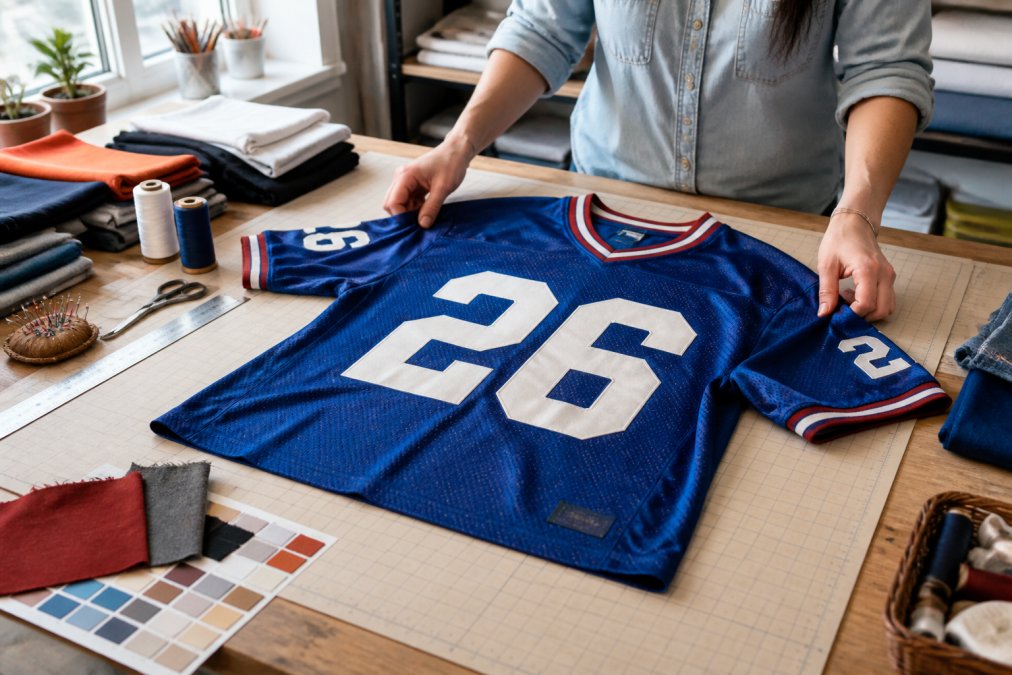
The process matters here. Decoupage and fabric application let a maker bond textile onto a rigid backing, which means a jersey can become wall art with the fabric's texture and patina intact. The material durability question changes too, because you're preserving something already decades old rather than manufacturing something new. The material durability question changes too, because you're preserving something already decades old rather than manufacturing something new.
If you're deciding what to do with a box of old gear, this is the moment fabric decor pulls ahead. Wood can't use your memorabilia. Fabric can.
Cost, Craftsmanship, and Environmental Impact
Cost and craftsmanship don't favor one material universally, but the structure of the cost does differ in ways most guides never spell out. The gap in the current market is a real cost-benefit breakdown, so here is how the money actually moves through each option.
Where the Money Goes: DIY vs. Custom-Ordered
A vintage wood sign has three cost layers: the substrate (a plank, a reclaimed board, or a pre-cut panel), the finish (stain, paint, sealer), and the labor (lettering, distressing, mounting hardware). If you do the work yourself, you eliminate the labor layer but you buy the tools, a miter saw, a sander, stencils or a cutting machine, and a sealer, and those tools only pay for themselves if you make more than one sign. A custom-ordered wood sign flips that: you pay for someone else's tools and time, but you buy exactly one finished piece with no leftover materials.
Custom fabric decor has a different cost shape. The textile is often the customer's own memorabilia, so the material cost is effectively zero to the maker and the price is dominated by labor: pattern work, cutting, stitching, mounting, and finishing. That means the cost scales with complexity, not with square footage. A simple doormat made from a single jersey panel costs less to produce than a wall hanging that requires piecing multiple garments, lining, and a rigid backing.
A common pattern: DIY wins on unit cost only at volume, while custom ordering wins on unit cost at quantity one. If you want a single heirloom piece, custom ordering usually beats buying tools you'll use once.
Craftsmanship: What You're Actually Paying For
Craftsmanship shows up differently in each material. Wood rewards a steady hand and clean typography, a wobbly letter or an uneven distress pattern is permanent and visible. Fabric rewards pattern work, stitching, and knowing how a textile will behave once it's mounted; a fabric that stretches or ravels under adhesive will fail in months, not years. When you compare quotes, ask what finishing step protects the piece: for wood, that's a sealer; for fabric, that's a backing or stabilizer that keeps the weave from distorting.
Environmental Impact: Two Different Reuse Stories
Reclaimed wood diverts old timber from landfills, and upcycled fabric keeps textiles in circulation. The U.S. Environmental Protection Agency's guidance on reducing waste notes that reusing existing materials conserves resources compared with making new ones, which is the core argument for both. The difference is sentimental: upcycled fabric carries the meaning of the original item, while reclaimed wood carries only the history of the material itself.
Which Option Fits Your Budget and Values?
If environmental impact drives your choice, upcycling wins on sentiment because the material already means something to you. If you want a single conversation piece with a fixed look and you already own woodworking tools, DIY wood is the simpler buy. If you want one finished heirloom and no tool investment, custom fabric decor is the lower-friction path.
Style Compatibility: Matching Wood or Fabric to Your Room
In wood vs fabric decor, style compatibility decides more purchases than durability ever does. Wood signs lean rustic, retro, and industrial. They anchor entryways, home bars, garages, and man caves, where a distressed finish and bold custom lettering read as intentional. Fabric decor leans soft and nostalgic, and it fits bedrooms, living rooms, and nurseries where a color palette needs to feel warm rather than rigid.
Think of it as a style compatibility matrix:
| Room | Better Fit | Why |
|---|---|---|
| Entryway | Wood | Bold statement, holds up to traffic |
| Living room | Fabric | Softens the space, invites touch |
| Bedroom | Fabric | Warmth and quiet texture |
| Home bar | Wood | Retro, distressed aesthetic |
| Nursery | Fabric | Safe, soft, washable |
| Garage | Wood | Rugged, high-impact wall art |
A common approach is to mix both. Use wood for the structural statement and fabric for the soft accents. That combination covers a room's visual texture without making it feel one-note.
The Smithsonian's guidance on caring for textiles and heirlooms is worth reading if you're storing or displaying something valuable, since light and humidity affect both materials more than most people expect.
The real challenge isn't picking a material. It's deciding what your memorabilia should become. MoonlightWeave turns vintage sports items into handcrafted fabric goods and home accessories, from cozy blankets and luggage tags to doormats, clocks, and cutting boards, so your history lives in your everyday space instead of a storage box. Our pieces are one-of-a-kind, made from the memorabilia you send, with the nostalgic value built in. Continue shopping with MoonlightWeave and turn that old jersey into something you'll actually use.
Frequently Asked Questions
Which is more durable: vintage wood signs or custom fabric decor?
Vintage wood signs hold up well indoors for decades, but they can warp, crack, or fade if hung in humid rooms or direct sunlight. Custom fabric decor made from quality textiles resists warping and feels softer, though it may need gentle cleaning over time. For high-traffic or moisture-prone areas, fabric often handles daily wear better; for a permanent, rigid statement piece, wood remains a solid choice. The right pick depends on where you plan to display it.
Can custom fabric decor provide the same nostalgic feel as vintage wood?
Yes, often more so. Fabric decor made from actual vintage memorabilia, like old jerseys or team blankets, carries personal history that a reproduction wood sign cannot match. The benefits of fabric home decor include warmth, texture, and a one-of-a-kind story. Wood signs deliver a classic rustic aesthetic, but if your goal is sentimental connection to a specific game or player, fabric built from the real thing tends to hit harder emotionally.
Are fabric-based home accessories easier to clean than wood signs?
It depends on the fabric and finish. Most custom fabric decor can be spot-cleaned with a damp cloth or vacuumed gently, which is simpler than sanding or refinishing a wood sign. Wood signs usually just need dusting, but stains or scratches require more effort to fix. For everyday upkeep, fabric accessories are generally lower-maintenance, though you should always follow the maker's care instructions to avoid damaging hand-painted or printed details.
How do I choose between rustic wood signs and fabric wall art for my space?
Start with the room. Rustic wood signs suit dens, man caves, and entryways where a bold, vintage sports aesthetic works. Fabric wall art fits bedrooms, nurseries, and cozy living areas where softness and personal storytelling matter more. Then factor in durability of wood vs fabric wall art: wood wins on rigidity, fabric wins on comfort and cleanability. Finally, consider whether you want a mass-produced look or a bespoke piece made from your own memorabilia.