

Table of Contents
- Step 1: Set Up the Right Environment
- Step 2: Handle Sports Memorabilia with Care
- Step 3: Choose Archival Storage Supplies for Sports Cards
- Step 4: How to Frame a Signed Jersey for Display
- Step 5: Pick the Best Display Cases for Sports Memorabilia
- Step 6: Prevent Pests, Mold, and Moisture Damage
- Step 7: Document, Insure, and Plan for Emergencies
- Frequently Asked Questions
Last Updated: September 13, 2026
Step 1: Set Up the Right Environment
Preserving valuable sports memorabilia at home starts with controlling two things most collectors ignore: light and moisture. This guide from MoonlightWeave covers the full process, from setup to emergency planning.
Ultraviolet light is the quiet killer of autographs and fabric; a signed jersey hung across from a window can fade within a single summer.
Light and UV Control
Direct sunlight causes irreversible fading. Move display pieces away from windows, or block UV rays with curtains and UV-filtering film.
UV-rated acrylic cases slow degradation. Rotate displayed pieces every few months so no single item absorbs light year-round.
Temperature and Humidity
A stable environment matters more than a perfect one, aim for consistency, not exact numbers.
- Keep items in climate-controlled rooms away from attics, basements, and garages
- Avoid hanging memorabilia near heating vents, fireplaces, or exterior doors
- Use a hygrometer to monitor humidity; sudden swings cause warping and moisture damage
- Store cards and paper items away from exterior walls where condensation forms
Sudden shifts do more harm than steady conditions: a jersey moved from a humid basement to a dry living room will crack and stiffen.
Step 2: Handle Sports Memorabilia with Care
Every time you touch a collectible, you leave oils, salts, and microscopic abrasions behind. Damage accumulates invisibly until it is obvious.
Handling Protocols for Autographed Items
Autograph preservation depends on what touches the surface. Rules for signed pieces:
- Wash and dry your hands before handling; skip lotion entirely
- Wear cotton or nitrile gloves for cards, photos, and paper items
- Hold framed pieces by the frame edges, never the glass or mat
- Support jerseys from underneath with both hands, never by the shoulders
- Keep food, drink, and pets away from your work area
- Lay items flat on a clean, padded surface before inspecting them
For signed balls and bats, handle the autograph area as little as possible. Skin oils break down ink over time.
Handling vs. Displaying Trade-Offs
The tension most guides skip: the pieces you love most are the ones you want to see, and displaying them wears them down.
The solution is curation: display two or three pieces, store the rest properly, and rotate seasonally so every item gets its moment without constant exposure.
| Item Type | Display Risk | Better Approach |
|---|---|---|
| Signed jersey | Fading, dust, stretching | Shadow box, rotated every 3-6 months |
| Autographed card | UV fading, corner wear | Sleeve and case, displayed briefly |
| Signed baseball | Ink fading, scuffing | UV display case, minimal handling |
| Vintage pennant | Fading, creasing | Flat storage, occasional display |
Step 3: Choose Archival Storage Supplies for Sports Cards
Archival storage supplies for sports cards are not optional extras. They are the difference between a card that holds value and one that yellows, warps, or sticks to its holder.
Sleeves, Cases, and Binders
The standard approach layers protection:
- Penny sleeves for everyday handling protection
- Rigid top loaders or card savers for valuable singles
- Acrylic cases for your highest-value cards, offering rigidity and UV resistance
- Acid-free binder pages for organized sets you flip through regularly
Skip PVC sleeves and pages; they off-gas and permanently damage cards. Use polyethylene or polypropylene instead.
Why Acid-Free Materials Matter
Acid-free materials prevent the reactions that turn paper brown and brittle. Cheap cardboard boxes, newsprint, and standard tape introduce acids that migrate into cards and photos.
Look for "acid-free" or "archival" labeling on every box, folder, and tissue you buy. It costs a little more and buys decades of protection.
Step 4: How to Frame a Signed Jersey for Display
Framing a signed jersey correctly protects both the autograph and the fabric; the wrong method pins, stretches, or glues it into permanent damage.
Framing Techniques for Flat Items
Flat items like photos, tickets, and letters need different treatment than jerseys:
- Mount the item on acid-free mat board using photo corners or archival tape
- Add a mat border so the item never touches the glass
- Use UV-filtering glass or acrylic glass in the frame
- Seal the back with acid-free backing board and dust cover
- Hang away from direct sunlight and heat sources
For jerseys, use a shadow box with a jersey mount or a custom hanger that supports the shoulders without pins. Never dry-clean a signed jersey before framing; solvents can lift the ink.
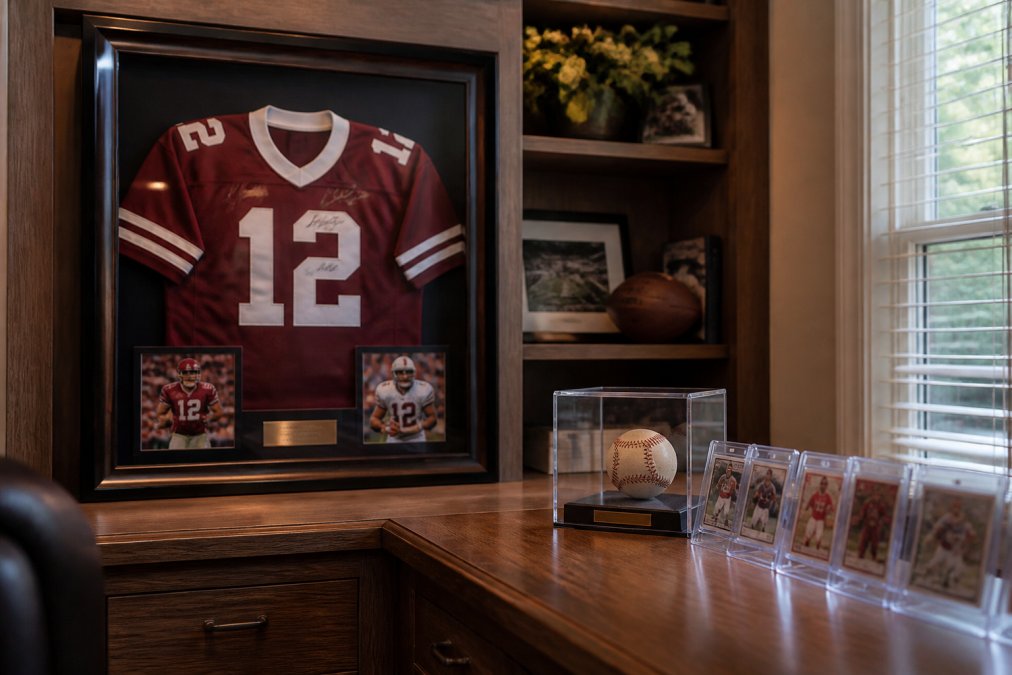
Step 5: Pick the Best Display Cases for Sports Memorabilia
The best display cases for sports memorabilia balance visibility against protection. Acrylic and glass both work; the choice depends on where the case will sit.
Shadow Boxes and Acrylic vs. Glass
Shadow boxes give depth for jerseys, balls, and equipment while keeping dust off. Acrylic is lighter and shatter-resistant; glass is heavier and scratches less easily.
- Acrylic: lighter, cheaper to ship, scratches more easily, good UV options
- Glass: heavier, clearer over time, better for permanent gallery wall setups
- Shadow box: best for jerseys, gloves, and three-dimensional items
Whichever you choose, keep the case out of direct sunlight and off hot surfaces.
Step 6: Prevent Pests, Mold, and Moisture Damage
Pests and mold destroy collections quietly, and both thrive in dark, damp, undisturbed spaces. But they have different causes and need different countermeasures, treating them as one issue is why so many collections still get hit.
Know What Is Actually Eating Your Collection
Different pests attack different materials; identifying the culprit tells you where to intervene:
- Silverfish feed on paper, cardboard, and the starch in book bindings. They leave irregular holes and yellowish stains, and they thrive in humid bathrooms, basements, and closets above 75% relative humidity.
- Carpet beetles and clothes moths attack wool, felt, and natural-fiber jerseys, pennants, and vintage uniforms. The larvae do the damage, not the adults, and they prefer dark undisturbed folds.
- Cockroaches feed on the starch and glue in cardboard boxes, photo albums, and book spines, and their droppings stain paper permanently.
- Rodents chew cardboard, paper, and even leather gloves, and their urine is acidic enough to etch autographs.
- Booklice (psocids) are a mold indicator, not a primary pest. If you see them, humidity is already too high and mold is likely present.
Mold: The Humidity Threshold That Matters
Mold spores are always present in household air, but they only germinate when relative humidity stays above roughly 60% for an extended period, growing fastest between 70% and 90%. A hygrometer is not optional, it warns you before you can smell anything.
A common pattern is a collection stored against an exterior wall or on a concrete floor. Those surfaces run cooler than the room air, so moisture condenses on them even when the room reads a safe 50%. Keep storage a few inches off the floor and away from exterior walls, and run a dehumidifier in any space that regularly reads above 55%.
Once mold sets into fabric or paper, do not wipe it off, wiping spreads spores deeper into the fibers. Isolate the item in a sealed bag and contact a conservator; for active mold on a valuable piece, professional treatment is the only safe option.
Storage Choices That Deter Pests
Pest prevention is mostly about denying access and removing attractants:
- Store textiles in sealed, acid-free boxes or garment bags rather than open shelves or dry-cleaner plastic.
- Never store memorabilia directly on concrete floors, which wick moisture and give pests a highway into your boxes.
- Use cedar or lavender sachets near, never touching, stored textiles. Cedar oil is a deterrent, not a pesticide, and it loses potency as it dries out; refresh or replace sachets annually.
- Vacuum storage areas and box exteriors every few months. Pests and their eggs hide in dust along baseboards and shelf edges.
- Inspect stored boxes on a set schedule, not when you happen to remember. Every three to four months is a reasonable cadence for a valuable collection.
What to Look For During Inspection
When you open a box, check for these specific signs before you close it again:
- Fine webbing or silken tunnels in fabric folds (moth or carpet beetle larvae)
- Irregular holes with yellowed edges in paper (silverfish)
- Small dark specks that smear when touched (frass or droppings)
- A musty, earthy smell (active mold, even if you cannot see it yet)
- Warping, cockling, or "foxing", the brownish spots that signal moisture exposure
Moisture Damage: Act Before It Sets
Water damage shows up as warping, foxing, and mold spots, and the window to intervene is short. If an item gets wet, separate it from dry pieces immediately, lay it flat on blotting paper or clean towels, and air-dry it with moving air. Do not stack wet items or use direct heat, heat sets stains and can cockle paper permanently. For high-value items, reach a conservator within 48 hours, before mold colonizes.
Prevention is cheaper than recovery every time. A few hours of inspection and a dehumidifier cost far less than a conservator's invoice.
Step 7: Document, Insure, and Plan for Emergencies
The administrative side of collecting is where most owners fall short, yet it is exactly what protects your investment when something goes wrong. Physical preservation keeps an item intact; documentation and insurance make it whole again if the worst happens.
Build a Documentation File Before You Need It
An insurance claim lives or dies on evidence. Build the file while everything is fine, not after a loss.
For each valuable piece, record:
- Clear photographs from multiple angles, including close-ups of autographs, serial numbers, holograms, and any manufacturer or grading labels
- Purchase records, receipts, auction invoices, or seller correspondence showing what you paid and when
- Provenance documents, certificates of authenticity, letters of provenance, or grading company reports
- A written description noting the item, the athlete or team, the year, the condition, and any distinguishing marks
- A replacement estimate, what it would cost to buy a comparable piece today, not what you paid years ago
Store the file in at least two places: a cloud folder and an off-site copy on a drive at a relative's home or in a safe deposit box. A file that lives only on the same shelf as the collection is worthless in a fire.
Appraisals: When and Why
Market values for sports memorabilia move, sometimes sharply after a championship, retirement, or death. A five-year-old receipt may badly understate today's value, and insurers pay on current value, not historical cost.
Serious collectors often have high-value pieces appraised every two to three years, and immediately after any event that likely moved the market. Use an appraiser who specializes in sports memorabilia or collectibles rather than a generalist, and ask for a written appraisal stating the intended use, insurance replacement value differs from fair market value for resale. Keep it with your documentation file and update your insurer when it changes materially.
Insurance: Why Standard Coverage Falls Short
Standard homeowners and renters policies typically cap collectibles at a relatively low sublimit, and that cap applies to the entire collection, not each item. A single signed jersey can exceed it, so a collection worth tens of thousands may be covered for only a fraction of its value.
The fix is usually one of two options:
- A scheduled personal property endorsement (a rider) that lists specific items by description and appraised value, often with no deductible for those items
- A standalone collectibles policy for larger or higher-value collections, which typically covers accidental damage, breakage, and sometimes loss in transit
Ask your insurer these questions before you need to file:
- Is there a per-item or per-category sublimit on collectibles?
- Does the policy cover accidental breakage, or only theft and named perils like fire?
- Is coverage on a replacement-cost basis or actual cash value?
- Are items in storage, in a safe deposit box, or in transit covered?
- What documentation is required at the time of a claim?
Get the answers in writing. A verbal assurance from an agent is not a policy term.
Emergency Recovery Steps
If water, fire, or mold hits your collection, the order of operations matters as much as the speed:
- Photograph everything before moving it. Insurers want to see the loss in place, and moving items first can complicate a claim.
- Separate wet items immediately and lay them flat to air-dry on blotting paper or clean towels. Do not stack them.
- Do not wipe mold. Isolate affected items in sealed bags and call a conservator. Wiping spreads spores.
- Freeze water-damaged paper items if you cannot reach a conservator quickly. Freezing suspends mold growth until a professional can treat the item. Wrap each item individually in freezer paper first so pages do not stick together.
- Contact your insurer within the timeframe your policy requires. Most policies set a prompt-notice requirement, and late notice is one of the most common reasons claims get denied.
- Keep every receipt for emergency stabilization, drying, or storage, since those costs are often reimbursable under a rider.
Preventative maintenance beats recovery every time. A few hours of documentation now saves months of loss later.
Frequently Asked Questions
What is the ideal humidity level for storing vintage sports cards?
Aim for a stable relative humidity between 35% and 50%. High humidity encourages mold and warping, while very low humidity can dry out and crack paper cards. A simple digital hygrometer from a hardware store costs less than a meal and tells you exactly what your room is doing. Keep cards in a climate-controlled room, away from basements and attics where swings are common. If you live in a humid region, a small dehumidifier or silica gel packets inside your storage bin can help maintain a stable environment.
How do I prevent UV damage to signed sports collectibles?
Keep signed items out of direct sunlight entirely. UV rays fade ink and break down fabric fibers even through window glass. For display, use UV-filtering acrylic glass on frames and cases. Rotate pieces so no single item stays in a bright spot year-round. If you have a gallery wall, place it on an interior wall away from south- and west-facing windows. For long-term storage, use opaque boxes and keep them in a dark closet. Even brief daily exposure adds up over decades.
Should I use glass or acrylic for displaying sports memorabilia?
Acrylic is lighter, shatter-resistant, and blocks more UV light when treated, which makes it a better choice for high-value items in homes with kids or pets. Glass is heavier and more scratch-resistant but breaks easily. For a signed jersey or a shadow box, acrylic with a UV-filtering coating offers the best protection. For a heavy trophy or a football helmet, glass works fine if the case sits on a stable shelf. Whichever you pick, make sure the case has a tight seal to keep out dust and pests.
What are the best archival materials for storing sports memorabilia?
Look for acid-free, lignin-free, and PVC-free materials. Acid-free boxes, tissue paper, and backing boards prevent yellowing and degradation. For cards, use non-toxic plastic sleeves made of polyethylene or Mylar, not PVC. Binders with pocket pages work for browsing, but store the binder upright in a cool, dark spot. For jerseys, wrap them in acid-free tissue and lay them flat in an archival box. Avoid cardboard and regular plastic bags, which release harmful chemicals over time and trap moisture.