

Table of Contents
- Why Proper Display Matters for Your Hockey Collection
- Hockey Jersey Display Ideas That Protect and Showcase
- UV Protection for Sports Memorabilia: Essential Defense
- Hockey Puck Display Case Solutions
- Climate Control and Humidity Management
- Budget-Friendly Display Solutions for Small Spaces
- Preservation Techniques for Long-Term Protection
- Frequently Asked Questions
Last Updated: September 1, 2026
Why Proper Display Matters for Your Hockey Collection
Your hockey memorabilia deserves better than a box in the closet. Whether you've got a signed jersey from your favorite player, vintage pucks from legendary games, or program covers spanning decades, how you display hockey memorabilia at home determines whether these pieces deteriorate or become centerpieces of your living space.
The stakes are real. Hockey collectibles face constant threats: UV light fades colors, humidity warps materials, temperature swings crack acrylic, and dust settles into fibers. But a jersey displayed correctly? It appreciates and stays protected simultaneously.
This isn't just about aesthetics, though that matters too. Proper display is preservation. It's the difference between owning memorabilia and maintaining an investment. At MoonlightWeave, we understand why collectors care so deeply about their hockey pieces, they're not just objects, they're memories made tangible. That's why we've created handcrafted home accessories that celebrate these collections while complementing how you display hockey memorabilia at home.
The right display solution does three things at once: it protects your items from environmental damage, showcases them so you actually see them every day, and fits your space and budget. That's the framework we'll walk through.
Hockey Jersey Display Ideas That Protect and Showcase
Custom Framing for Jerseys
Custom framing is the gold standard for jersey display. A properly framed hockey jersey sits behind UV-protective glass, mounted on archival matting with acid-free materials that won't yellow or deteriorate over decades. The jersey itself is secured with conservation-grade thread, never glued or stapled.
The frame becomes invisible, what matters is what's inside. Your 1980s Gretzky jersey or vintage Original Six sweater becomes wall art, lit properly so the details pop without fading. Custom framing costs more upfront (typically $300-$800 depending on jersey size and frame quality), but it's a one-time investment that protects an asset indefinitely.
When selecting a framing shop, look for these specifics: they should use UV-protective glass (not acrylic, glass blocks more UV), acid-free matting, and archival-quality backing. Ask if they've framed sports memorabilia before. Experience matters here. A framer who understands jersey construction knows how to mount without damaging the fabric or distorting the shape.
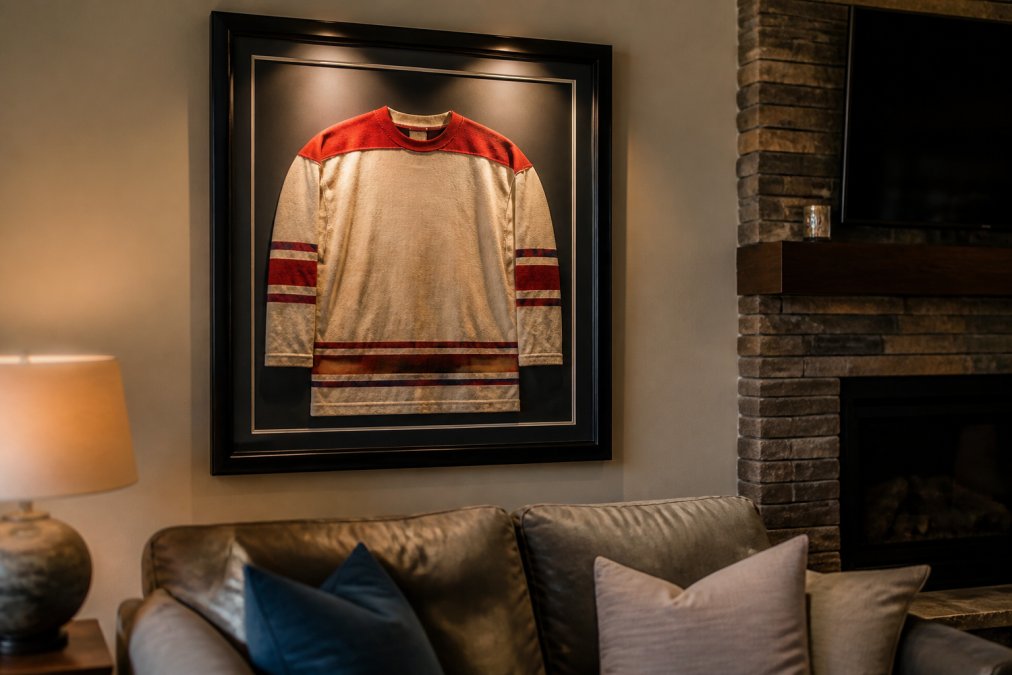
One detail most people miss: the mounting method. Conservation-grade framing uses polyester straps or slots that hold the jersey without puncturing or stressing the fabric. Cheap framing uses nails or adhesive. After a few years, that damage becomes permanent.
Wall-Mounted Display Racks
For collections spanning multiple jerseys, wall-mounted display racks offer flexibility without the cost of individual frames. These racks hold jerseys on hangers, keeping them visible and accessible. The best ones use padded hangers so fabric doesn't crease or stretch.
Wall-mounted racks work best in dedicated spaces, a man cave, game room, or home bar where you've got vertical wall real estate. They're especially good if your collection rotates seasonally or if you like changing what's on display. Unlike custom framing, you can swap jerseys in seconds.
The trade-off: jerseys on racks are exposed to more dust and ambient light. They need regular rotation to prevent uneven fading. If you go this route, keep the display area away from direct sunlight and consider a glass enclosure around the rack to reduce dust accumulation.
UV Protection for Sports Memorabilia: Essential Defense
UV light is the silent killer of hockey memorabilia. It fades colors, breaks down fabric fibers, and yellows autographs. A jersey displayed in direct sunlight for two years can fade as much as one stored in a dark closet for twenty.
The solution is UV-protective glass or acrylic. Real UV-protective glass blocks 99% of ultraviolet rays. Acrylic blocks about 85%, which is still significant but not ideal for high-value items. Glass is heavier and more expensive; acrylic is lighter and cheaper. For jerseys, glass wins. For pucks and smaller items, acrylic is acceptable.
Positioning matters too. Never display memorabilia in direct sunlight, even with UV protection. Indirect natural light is fine. Better yet, use accent lighting, LED spotlights that emit minimal UV. Modern LED lights designed for display purposes produce almost no UV radiation, so you get visibility without degradation.
Here's what most people get wrong: they think UV protection is only about framing. It's not. It's about the entire environment. A UV-protective frame in a room with intense afternoon sun still fades. A frame in a dim corner with no direct light stays vibrant for decades. Combine both, UV-protective materials AND smart room positioning, and your memorabilia stays pristine.
Hockey Puck Display Case Solutions
Shadow Boxes and Acrylic Cases
Shadow boxes are the standard for signed pucks. A shadow box is a shallow display case, typically 8x10 or 12x12 inches, with a deep frame and glass front. Inside, the puck sits on a custom mount, often on a wooden base or acrylic riser. The depth of the box keeps the puck visible while protecting it from dust and handling.
Acrylic cases offer similar protection in a more compact form. These are clear plastic boxes, sometimes with custom mounts, that sit on a shelf or table. Acrylic is lighter than glass and won't shatter if dropped. For collections of multiple pucks, acrylic cases stack or line up neatly.
The key difference: shadow boxes are wall-mounted and permanent. Acrylic cases sit on surfaces and are easy to move. Shadow boxes feel more intentional and gallery-like. Acrylic cases feel more casual and flexible.
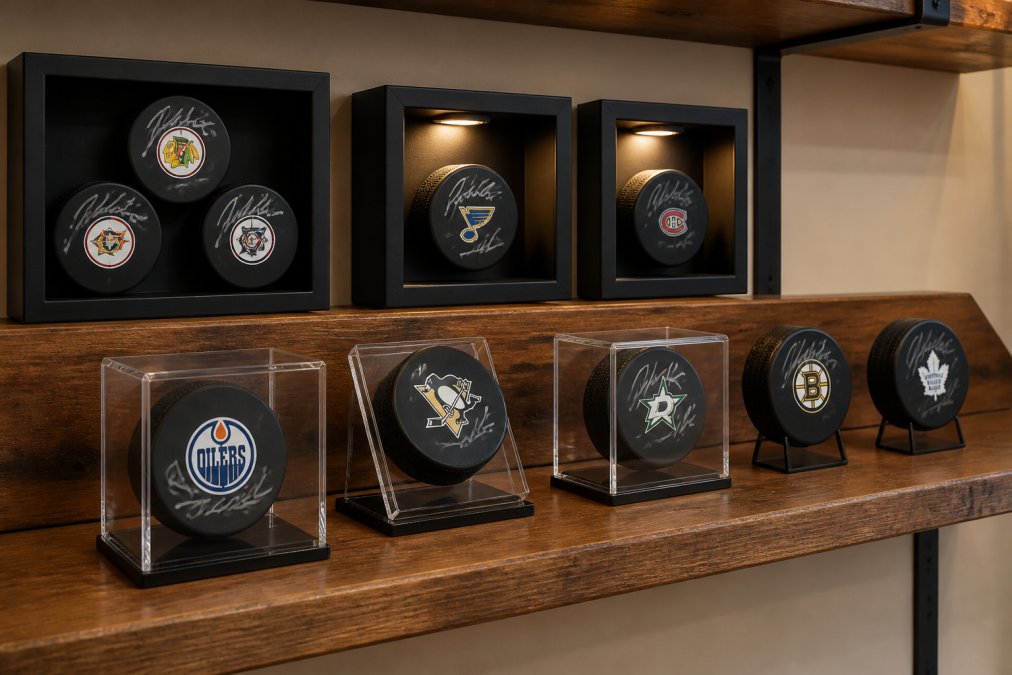
When choosing between them, consider your space and collection size. Five pucks? Acrylic cases on a floating shelf. Twenty pucks? A wall of shadow boxes. Either way, ensure the interior is lined with archival-quality foam or velvet that won't off-gas chemicals onto the puck.
Floating Shelves for Pucks and Signed Items
Floating shelves create a clean, modern look for displaying multiple pucks, signed photos, or smaller memorabilia. They're wall-mounted but appear to float, which makes the items seem to hover. Shelves work especially well in tight spaces where a full shadow box collection isn't practical.
The challenge with floating shelves is dust and light exposure. Pucks on open shelves accumulate dust faster than pucks in cases. They're also more vulnerable to UV fading if the shelf sits near a window. Mitigate this by placing shelves away from direct sunlight and dusting regularly (monthly is reasonable for a collection you actually want to preserve).
Use floating shelves for items you genuinely want to see and interact with. They're not the best choice for ultra-rare or high-value pucks, those belong in shadow boxes. But for a collection of game-used pucks from seasons you watched, or signed items you want to enjoy daily, floating shelves strike the right balance between display and practicality.
Climate Control and Humidity Management
Temperature and humidity are the invisible forces that wreck memorabilia. Hockey pucks can crack if humidity swings wildly. Jerseys can develop mold if the air is too damp. Autographs fade or ink can run if conditions fluctuate.
Ideal conditions: 65-70°F and 45-55% relative humidity. That's stable, cool, and not too dry. Most homes don't maintain this naturally. Basements are often too damp. Attics get too hot. Living rooms near heating vents fluctuate constantly.
If you're serious about preservation, invest in a small humidifier or dehumidifier for the display area. A hygrometer (humidity meter) costs $15-$30 and tells you exactly what you're dealing with. Measure your display space for a week. If humidity swings more than 10% daily, you need climate control.
For smaller collections or tight budgets, focus on location. Display memorabilia in interior rooms away from exterior walls, heating vents, and direct sunlight. These spots naturally maintain more stable conditions. A bedroom closet is often more stable than a living room wall.
Budget-Friendly Display Solutions for Small Spaces
Not everyone has a dedicated man cave or thousands to spend on custom framing. Budget-conscious collectors need solutions that work in apartments, small homes, or shared spaces.
Start with what you have: floating shelves from any hardware store ($20-$50), basic acrylic cases ($10-$30), and LED strip lighting ($15-$40). A single floating shelf with three acrylic puck cases and subtle LED backlighting costs under $100 and looks intentional, not cramped.
For jerseys in small spaces, consider a single custom frame (one favorite jersey) rather than multiple wall-mounted racks. One beautifully framed piece in a bedroom or hallway makes a stronger statement than three mediocre frames crammed into a corner.
Alternatively, rotate your display. Keep most items in acid-free storage boxes, and rotate what's on display every few months. This protects items from constant light exposure while letting you enjoy different pieces throughout the year. It also makes your space feel fresh without requiring new storage.
MoonlightWeave offers another approach: handcrafted fabric goods and home accessories that celebrate your collection without requiring wall space or special cases. Our Velveteen Plush Blanket featuring the Detroit Red Wings 1954 Hockey Program Cover ($42.95) lets you enjoy vintage hockey imagery on a functional piece you use daily. It's display without the preservation headache, and it works in any space.

Preservation Techniques for Long-Term Protection
Preservation starts before display. How you store items before they go on the wall determines how well they'll hold up.
Acid-free storage boxes are non-negotiable. Regular cardboard boxes leach acid that yellows and weakens fabric over time. Acid-free boxes cost a bit more but preserve items indefinitely. Store jerseys flat or loosely folded (never crammed), wrapped in acid-free tissue. Store pucks in individual compartments with padding between them.
For signed items, protect the autograph. If a jersey or puck has a signature, that's the most vulnerable part. For high-value pieces, leave signatures uncoated and rely on display cases with UV protection instead.
Handling matters too. Wear cotton gloves when touching memorabilia. Skin oils transfer to fabric and can cause staining or degradation over time. It sounds extreme, but for items worth real money, it's standard practice.
Inspect your collection annually. Look for signs of fading, mold, insect damage, or material breakdown. Catch problems early. A small spot of mold can be treated. Widespread mold means professional conservation, which is expensive.
According to the Smithsonian's guidelines on textile preservation, proper storage and display conditions can extend the life of fabric artifacts by decades. The key is consistency, stable temperature, stable humidity, minimal light exposure, and protection from physical handling.
Document your collection. Take photos of each item with close-ups of signatures, condition, and any notable details. Store these digitally and in printed form. If something is ever damaged, lost, or stolen, documentation helps with insurance claims and proves provenance.
Your hockey memorabilia tells the story of games you watched, players you admired, and moments that mattered. Displaying it properly means those pieces stay vibrant and valuable for decades. Whether you go with custom framing, shadow boxes, or floating shelves, the core principles stay the same: protect from UV light, control humidity, minimize handling, and position thoughtfully.
Start with one piece. Frame that favorite jersey or display your most cherished puck. Once you see how good it looks and how well it holds up, expand from there. MoonlightWeave can help you celebrate your collection with handcrafted pieces like our Vintage New York Americans Hockey Program Cover Ceramic Mug ($20.45), a way to enjoy hockey nostalgia in your daily routine while your prized pieces stay protected on display.

Frequently Asked Questions
How do you display hockey jerseys without damaging them?
Use custom framing with acid-free matting and UV-protective glass to display jerseys safely. Mount jerseys on archival-quality backing, avoid direct sunlight, and ensure proper humidity control (40-50%). Wall-mounted display racks with padded hangers also work well for rotating jerseys while keeping them visible. Never pin or staple directly into fabric, as this causes permanent damage.
What is the best way to preserve signed hockey pucks?
Store signed pucks in shadow boxes or acrylic display cases with UV-protective materials. Keep them away from direct sunlight and maintain stable temperature and humidity levels. Use archival-quality mounting materials if securing them inside cases. Avoid handling signed pucks with bare hands; wear cotton gloves to prevent oils from damaging signatures. Store backup documentation of authenticity separately.
How can I create a hockey-themed display wall on a budget?
Combine DIY solutions like floating shelves ($15-40 each), shadow boxes you assemble yourself ($20-50), and wall-mounted racks ($30-60) to display memorabilia affordably. Use existing wall space creatively and rotate items seasonally to refresh your display. Consider handcrafted pieces like vintage hockey-themed blankets or mugs as accent decor alongside framed jerseys and pucks to build a curated collection without expensive custom work.
How do you protect sports memorabilia from UV light damage?
Install UV-protective glass or acrylic in display cases, shadow boxes, and framing. Use window treatments like UV-filtering film or light-blocking curtains to reduce direct sunlight exposure. Position displays away from windows when possible, and use display lighting with UV-filtered bulbs instead of natural light. Check items regularly for fading and rotate displays periodically to ensure even light exposure across your collection.
This article was written using GrandRanker