

Table of Contents
- Assess Your Memorabilia's Value and Condition
- Document Everything with Photography and Condition Reports
- Choose the Right Packaging Materials for Protection
- Shipping Insurance for Collectibles: What You Need
- USPS vs UPS vs FedEx for Valuables: Which Carrier Wins
- Create a Shipping Manifest and Handle Customs Documentation
- Navigate the Claims Process if Damage Occurs
- Conclusion
Last Updated: August 20, 2026
Assess Your Memorabilia's Value and Condition
Before shipping valuable memorabilia, understand both monetary value and physical condition, these determine packing aggressiveness and insurance needs.
Get a professional appraisal if your item exceeds a few hundred dollars. A written appraisal documents condition, rarity, and market value, providing proof for insurance claims. For vintage sports cards, jerseys, or signed memorabilia, this transforms vague estimates into defensible numbers.
Conduct a thorough condition assessment yourself. Look for tears, stains, fading, creases, foxing, or previous damage. Document everything in writing as your baseline. Take photos from multiple angles in natural light, harsh overhead lighting can hide or exaggerate damage. Common issues affecting shipping decisions include moisture damage (requiring moisture barriers), loose bindings (needing extra cushioning), and delicate surfaces like autographs (requiring archival-grade protection).
Document Everything with Photography and Condition Reports
Documentation is your insurance. If damage occurs, photos and a written condition report determine whether claims are paid or denied.
Photograph your memorabilia before packing using natural lighting. Capture front, back, and all sides. For cards, photograph both sides separately. For jerseys, photograph signatures, tags, and labels in detail. For three-dimensional items, take at least four photos from different angles.
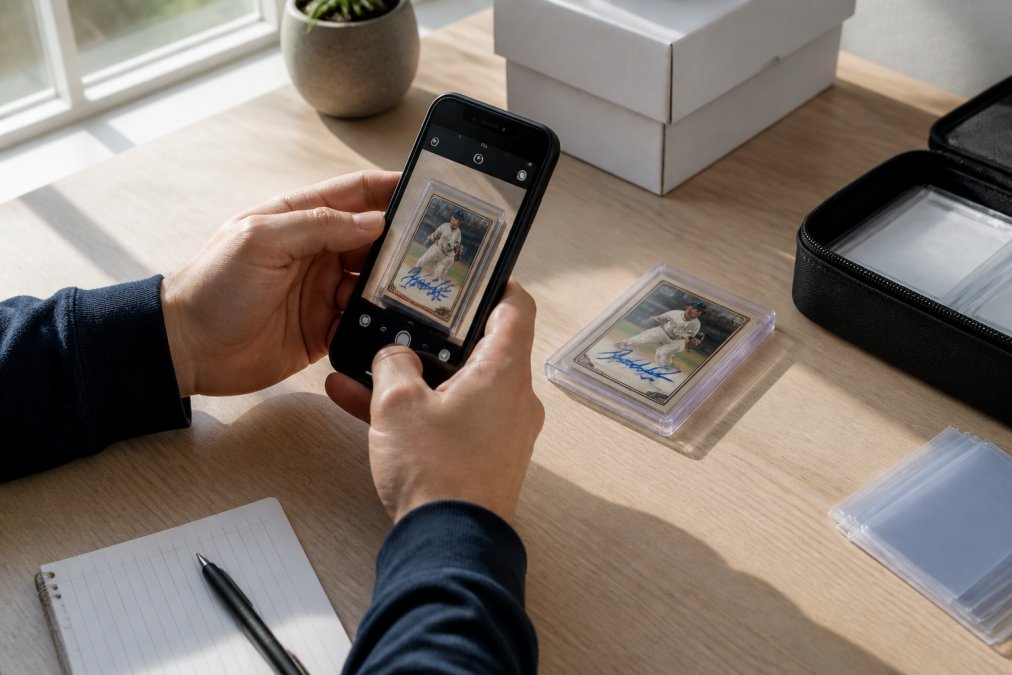
Write a condition report describing facts, not guesses. "Signature appears to be in black ink, consistent with items from this era" is better than "authentic signature." Note specific wear: "Small crease in upper left corner, approximately 1/8 inch long" beats "minor damage." Include the date and your name.
Store photos and reports digitally and in print. Email them to yourself for timestamping. This chain of custody is what insurers respect. For high-value items, have a professional grader or appraiser create the condition report for added credibility.
Choose the Right Packaging Materials for Protection
Wrong materials cause more damage than shipping itself. Acid-free tissue paper is non-negotiable for vintage items.
Start with archival-grade materials. Acid-free tissue paper prevents deterioration of paper-based memorabilia. Acid causes yellowing and brittleness. For vintage sports cards, use acid-free sleeves before wrapping. For jerseys, wrap in acid-free tissue first.
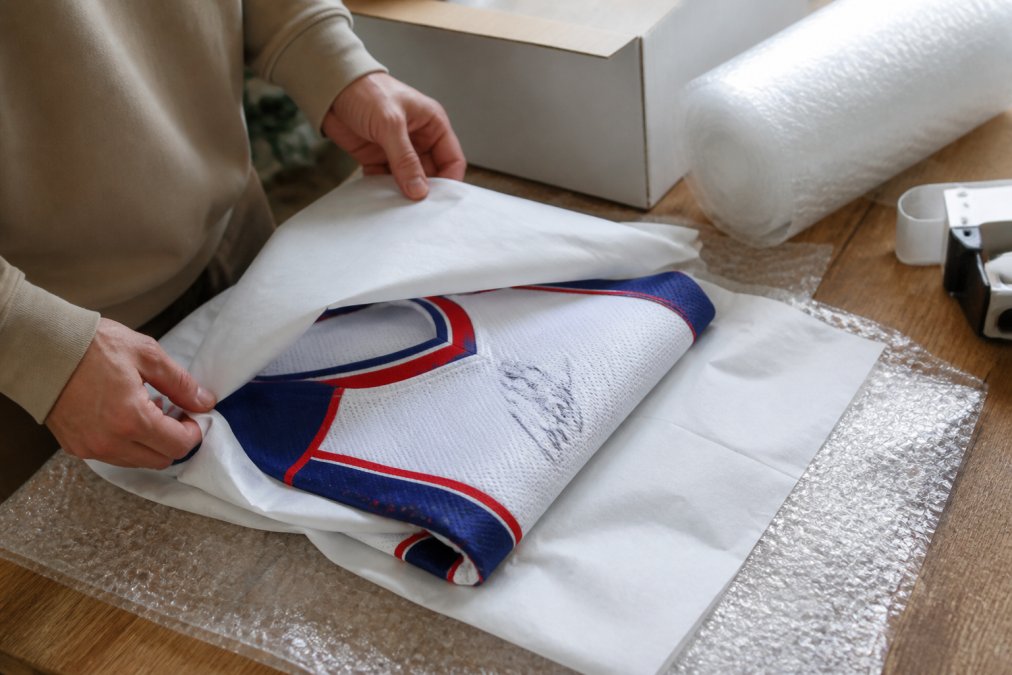
Choose cushioning carefully. Closed-cell foam or polyethylene foam provides better shock absorption than standard bubble wrap, especially for fragile items. For delicate surfaces like autographs, use foam sheets as a buffer between the item and bubble wrap.
Add corner protectors to prevent edge damage. For boxes, use cardboard corner guards or foam protectors. For framed memorabilia or signed photos worth thousands, custom crating with corner protectors is justified.
For moisture protection, use a thin polyethylene barrier between the item and outer box. This prevents condensation and water intrusion while allowing airflow, the key is blocking liquid without trapping moisture inside.
Double-Boxing Method for Maximum Cushioning
The double-boxing method creates a shock-absorbing layer between two rigid containers, allowing the inner box to move without the item moving.
Pack your item in an appropriately-sized inner box using cushioning materials. Use void fill to eliminate gaps. The item must not move when you shake the box. Seal with strong packing tape on all seams, reinforcing corners.
Create the outer box 4-6 inches larger on all sides. Place 2-3 inches of void fill on the bottom, set the sealed inner box in the center, and fill sides and top with void fill. The inner box should not touch outer walls. Seal the outer box identically with reinforced corners.
Use triple-ply corrugated boxes for valuable items. The cost difference is minimal, and protection is measurably better.
How to Pack Vintage Sports Cards
Vintage sports cards require specific handling because value depends entirely on condition. Mint condition cards are exponentially more valuable than good condition ones.
Place the card in an acid-free sleeve with the printed side facing the opening to prevent sliding. Use an acid-free holder or top-loader to keep the card flat and prevent bending. Do not use regular plastic sleeves, they trap moisture and contain damaging chemicals.
Group holders in an acid-free box or container, filling gaps with acid-free tissue or kraft paper. Avoid loose packing peanuts directly against holders. Place this container in a padded mailer or small inner box with cushioning, then into the outer box with void fill using the double-boxing method. packing fragile items.
For single high-value cards (over $500), use double-boxing. For collections, group logically and pack each group separately before combining in the outer box.
Shipping Insurance for Collectibles: What You Need
Shipping insurance is non-negotiable, it's your only protection if something goes wrong.
Declared value is the amount you tell the carrier your package is worth. This limits carrier liability if the package is lost or damaged. USPS, UPS, and FedEx have different declared value limits and coverage rules. You must declare actual value; undervaluing means you'll only recover the undervalued amount.
Transit insurance covers loss or damage during shipping, separate from declared value. You purchase it through the carrier or a third-party insurer at typically 1-2% of declared value. For a $1,000 item, transit insurance costs $10-20.
Verify your insurance covers your specific item type. Sports memorabilia is usually covered, but signed items or vintage collectibles sometimes have restrictions. Read policy details.
Keep condition reports, photos, and appraisals in a separate file. Claims must be submitted within 30-60 days of delivery. Missing deadlines forfeits claims, even with perfect documentation.
Consider full-value coverage if available. For items worth more than $2,000, this extra cost is justified.
USPS vs UPS vs FedEx for Valuables: Which Carrier Wins
Each carrier has different strengths for high-value shipments.
USPS Priority Mail Express offers declared value up to $5,000 with included signature confirmation. Good for items under $1,000 with lower costs and 1-2 day delivery. However, USPS has the lowest liability limits and most restrictive insurance policies. For items over $2,000, USPS becomes risky.
UPS offers declared value up to $100,000 with better handling procedures for fragile items. UPS charges more but provides better coverage and handling for items worth $1,000-$5,000. Signature confirmation and delivery confirmation are standard.
FedEx offers comparable coverage to UPS with detailed real-time tracking. For cross-country or international shipments, FedEx often has better international insurance options.
For items under $500, use USPS Priority Mail Express with declared value and signature confirmation. For $500-$2,000, use UPS or FedEx with declared value and signature confirmation. For items over $2,000, use UPS or FedEx with full-value coverage and signature confirmation.
Always choose signature confirmation, the recipient must sign, creating a delivery timestamp and proof of arrival.
Create a Shipping Manifest and Handle Customs Documentation
A shipping manifest records what you're sending, its condition, and value. This protects you if disputes arise.
Create a manifest including: item description, condition summary, declared value, photo file names, insurance policy number, tracking number, and date shipped. Keep this with your records. For multiple items, list each separately.
For international shipments, complete customs declarations accurately. Undervaluing items to avoid customs fees is illegal and causes holds, destruction, or returns. Customs duties are the recipient's responsibility. Declare correct value to prevent delays.
For vintage memorabilia, declare it as "vintage sports memorabilia" or "collectible merchandise" with estimated value from your appraisal. Note if it's a gift, some countries have different duty rates for gifts versus sales.
Keep a copy of the customs declaration with your records for resolving delays or holds.
Navigate the Claims Process if Damage Occurs
Understanding the claims process before shipping means knowing exactly what to do if something goes wrong.
File a claim immediately upon discovering damage, most carriers have 30-60 day timelines. Do not open the package further than necessary. Take photos of the damaged item and packaging.
Submit your claim with: tracking number, damage photos, pre-shipping condition report, pre-shipping photos, insurance receipt, and written damage description. Some carriers require holding the damaged package for inspection, follow their instructions exactly.
Expect 2-4 weeks for investigation. The carrier will approve the claim and issue payment, request additional information, or deny with written explanation. If denied, you can appeal with additional documentation or escalate to a supervisor.
For valuable items, consider hiring a claims adjuster or attorney if the claim is denied and value is significant.
When you safely ship valuable memorabilia, you're preserving memories and history. The process requires patience and attention to detail: assess and document condition before packing, use archival-grade materials and double-boxing, purchase appropriate insurance, and choose a carrier with strong liability protections.
If you're considering having your memorabilia transformed into something wearable or displayable, MoonlightWeave specializes in handcrafting vintage sports items into unique fabric goods and home accessories. Before shipping to a custom maker, apply these same shipping principles, protect your original memorabilia with proper documentation, archival materials, and insurance so it arrives safely, ready to become something you'll treasure for decades.
| Carrier | Best For | Declared Value Limit | Signature Confirmation |
|---|---|---|---|
| USPS Priority Mail Express | Items under $1,000 | $5,000 | Included |
| UPS Ground/2nd Day Air | Items $1,000-$5,000 | $100,000 | Available |
| FedEx Ground/Overnight | Items $1,000-$5,000 | $100,000 | Available |
Frequently Asked Questions
What is the safest way to ship high-value items?
Use the double-boxing method with archival-grade, acid-free materials for inner protection and sturdy corrugated cardboard for the outer box. Fill all void spaces with cushioning material like foam peanuts or crinkled paper. Add shock-absorption padding in the corners. Always purchase transit insurance with declared value matching your memorabilia's worth, and choose a carrier offering signature confirmation and tracking. Document the item's condition with photos before shipping.
How do I insure high-value collectibles during transit?
Declare the full value of your memorabilia to your chosen carrier and purchase their declared value or transit insurance option. Keep receipts, appraisals, or condition reports as proof of value. Some carriers cap coverage amounts, so verify limits before shipping. For items worth thousands, consider specialty collectibles insurance through third-party providers. Always use signature confirmation and require proof of delivery to strengthen any future claims.
What's the difference between USPS, UPS, and FedEx for shipping valuables?
USPS Registered Mail offers strong security and tracking but has lower coverage limits (typically $100,000 maximum declared value). UPS and FedEx both provide higher declared value options and signature confirmation. FedEx tends to offer slightly better tracking transparency and faster transit times for high-value items. UPS is often more cost-effective for domestic shipments. Compare declared value limits and insurance costs across carriers for your specific memorabilia value before deciding.
Should I use original packaging when shipping memorabilia?
Original packaging adds provenance and value to vintage memorabilia, but it may not provide adequate protection during transit. If the original packaging is valuable itself, photograph it thoroughly and consider storing it separately. Use the original packaging as your innermost layer, then apply the double-boxing method with additional archival-grade cushioning around it. Never rely on original packaging alone for shipping, it's designed for display, not impact resistance during transit.
This article was written using GrandRanker