

Table of Contents
- Why Retro Sports Rooms Are Making a Comeback
- Idea 1: The Vintage Locker Room Retreat
- Idea 2: The Nostalgic Stadium Wall
- Idea 3: DIY Vintage Sports Room Projects on a Budget
- Idea 4: Sports Memorabilia Home Decor That Works Every Day
- Idea 5: The Multi-Sport Fan Cave with Retro Lighting
- Picking Your Retro Sports Room Color Palette
- Conclusion
- Frequently Asked Questions
Last Updated: September 10, 2026
Why Retro Sports Rooms Are Making a Comeback
Nostalgia sells. Fans who grew up watching games on rabbit-eared TVs now have disposable income and a spare room, and they want the retro sports room they never had as kids. This guide breaks down five themes that work, with real budgets and sourcing advice.
A retro sports room is a themed interior space that uses vintage-era sports memorabilia, distressed finishes, and nostalgic color palettes to recreate the feel of a 1960s or 1970s stadium, locker room, or fan cave. Unlike a man cave, every piece is curated, not collected randomly.
Idea 1: The Vintage Locker Room Retreat
The locker room is the most underrated theme in sports decor, and the easiest on a modest budget. Metal lockers, a bench, and turf underfoot do most of the work.
Locker-Style Storage and Distressed Finishes
Vintage steel lockers run from flea-market finds to restored gym surplus. Look for chipped paint and rust patina rather than a fresh powder coat. If you find a clean set, scuff it with fine sandpaper and a wire brush, then seal it so rust doesn't spread.
A common mistake is buying lockers that are too deep. Standard gym lockers are 18 inches deep and eat an entire wall; slimmer 12-inch units read the same and leave room for a bench.
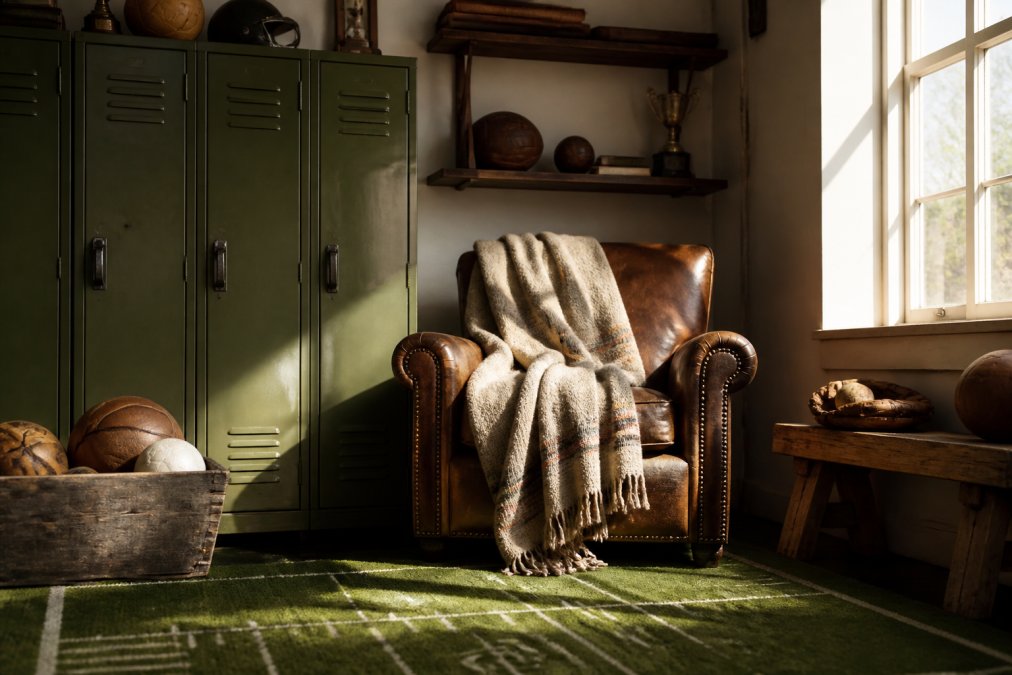
Turf Rugs and Athletic Textiles
Turf-inspired rugs signal "athletic" without carpeting a whole room. Real turf sheds and holds odor, so choose a turf-look polypropylene rug instead.
Layer textiles on top: a velveteen throw adds softness against all that hard metal. MoonlightWeave's 1962 Vintage Bears Football Velveteen Plush Blanket at $42.95 does this job, with a vintage 1960s football illustration framed by a black border that reads retro without shouting.

Idea 2: The Nostalgic Stadium Wall
The stadium wall is your focal point. Done well, it's the first thing every guest photographs. Done badly, it's a cluttered bulletin board.
How to Display Sports Memorabilia Like Jerseys and Pennants
Displaying sports memorabilia well comes down to four rules: one hero piece per wall, consistent framing, breathing room, and correct mounting hardware. Most collectors break at least two.
- Hero piece: one jersey, one large pennant, or one framed program
- Framing: match frame finish across the wall, or group by era
- Spacing: leave at least 3 inches between frames
- Hardware: match the anchor to the weight, not the look
Jerseys should be stretched over an acid-free backing board, never pinned directly, pins leave holes that permanently reduce value, and acidic cardboard backing yellows fabric. Look for mats labeled acid-free or lignin-free, and ask whether the backing is foam core or corrugated board; foam core holds a jersey's shape better under tension.
Archival Framing, UV, and Valuation Basics
- UV-filtering glazing: Acrylic with a UV filter blocks most fading from sunlight and fluorescent bulbs; standard glass does not. Non-negotiable within a few feet of a window.
- Light exposure: Even UV-filtered pieces fade over years. Rotate your hero piece off the wall every few months if the wall gets direct sun.
- Humidity: Basements and garages swing in humidity, warping paper and encouraging mildew on wool and felt. Keep framed paper goods in conditioned space.
- Handling: Cotton gloves for anything paper or fabric. Skin oils transfer and stain.
On value: condition drives price more than age. A faded pennant with a torn tip is worth a fraction of a clean one, and a jersey with pin holes is worth less than the same jersey unfolded. If a piece might be worth real money, get it appraised before you mount it, mounting choices are hard to reverse.
Vintage Pennants and Banners as Focal Points
Original felt pennants from the 1950s through the 1970s are still findable at estate sales and antique malls, and they're the cheapest way to fill a large wall. The felt fades; that's the point. Faded color is authentic, and reproductions rarely match it.
Hang pennants on a simple wooden dowel with brass clips rather than framing each one. It keeps costs down and lets you rearrange as your collection grows. For a single standout pennant, a shadow box with a felt backing reads more like a museum piece.
A few sourcing notes:
- Spine vs. tip: Check the seam along the spine. Original pennants have a stitched or taped spine; many reproductions use a glued edge that peels.
- Size: Full-size pennants run roughly 12 by 30 inches. Mini pennants are common and cheap but read as filler on a large wall.
- Reproductions: Modern reprints often have brighter, more saturated color and a printed (not stitched) design. If authenticity matters, look for the stitched lettering and a slightly irregular edge.
Hanging Weight and Wall Safety
A framed jersey with glass can weigh 10 to 20 pounds. A shadow box with multiple items can exceed that. Drywall anchors rated for the load are fine for light frames, but anything heavy should hit a stud or use a French cleat rated well above the piece's weight. When in doubt, size up the anchor, a failed frame takes the memorabilia with it.
Idea 3: DIY Vintage Sports Room Projects on a Budget
Not every piece needs to be an original. Some of the best retro sports room projects are upcycled, and they cost a fraction of the real thing.
Upcycled Memorabilia and Repurposed Finds
Old wooden crates become shelving. Broken hockey sticks become coat racks. Worn-out leather gloves become wall mounts.
A practical starter project:
- Source 3 wooden produce crates from a farm stand
- Sand lightly, leave the original stenciling intact
- Stain with a dark walnut wipe-on
- Mount with L-brackets at staggered heights
- Fill with trinkets, balls, and programs
Budget-Friendly vs. High-End Accents
Spend on the pieces people touch, save on the pieces they only see.
| Element | Budget Approach | High-End Approach | Where It Matters Most |
|---|---|---|---|
| Wall art | Reproduced program covers | Original framed lithographs | Low impact |
| Seating | Secondhand leather club chair | Restored stadium seats | High impact |
| Lighting | Vintage brass desk lamp | Restored industrial pendant | Medium impact |
| Textiles | Turf-look poly rug | Wool stadium blanket | High impact |
| Barware | Retro mixing glass | Crystal decanter set | Medium impact |
Put money into seating, textiles, and anything you physically use. Save on wall art, where a good reproduction reads the same from three feet away.
Idea 4: Sports Memorabilia Home Decor That Works Every Day
The real test of sports memorabilia home decor is whether the room still functions as a room. If you can't sit down without moving a helmet, you've built a museum, not a retreat.
Jersey Display Cases and Shadow Boxes
A jersey display case protects the piece and elevates it. Look for UV-filtering acrylic, which slows the fading that kills fabric value. Shadow boxes work better for groupings: a ticket stub, a program, and a photo in one frame tell a story a lone jersey can't.
Mount cases at eye level, roughly 60 inches from the floor to center.
Leather Furniture and Industrial Accents
Leather and metal carry this aesthetic. A worn leather club chair next to a brass floor lamp and a distressed wood console is a complete vignette.
For barware that fits the theme, MoonlightWeave's Vintage 1930 Football Harvard-Army Mixing Glass at $21.95 brings the era into your hand. It's dishwasher-safe, holds 16 ounces, and has the heavy solid base cheap printed glassware lacks.
Idea 5: The Multi-Sport Fan Cave with Retro Lighting
Multi-sport rooms fail for one reason: clutter. The fix is unification, not subtraction. And the most ignored element in sports room design, lighting, separates a room that feels curated from one that feels like a storage unit.
Lighting Design for a Warm, Nostalgic Glow
The rule: no overhead white light. Use bulbs in the 2700K range or warmer, and build three layers.
- Base layer: a brass or matte-black floor lamp with a shaded bulb, placed in a corner to wash the room.
- Mid layer: one or two table lamps on side tables or a console. These light faces and surfaces, which makes a room feel inhabited.
- Accent layer: a single adjustable fixture, a picture light, a wall sconce, or a clamp lamp, aimed at your focal wall. This makes the memorabilia read as a display instead of a pile.
The retro look comes from materials and shade shape, not from being genuinely old. Look for:
- Brass or aged-brass finishes that patina rather than flake
- Opaque or semi-opaque shades (metal, glass, or linen) that push light down and up rather than sideways into eyes
- Edison-style bulbs at 2200K-2700K for the accent layer only, too dim and too orange for base lighting
A common mistake is buying one very bright fixture and calling it done. Three dim sources at different heights beat one bright source every time. If your room has a ceiling fixture you can't remove, put it on a dimmer and use it only when cleaning.
Mixing Sports Without the Clutter
Pick a unifying thread and stick to it. The easiest threads are era, color, and material.
- Era: everything from the 1960s, regardless of sport
- Color: a two-color palette drawn from your primary team
- Material: brass, leather, and distressed wood across all sports
A vintage 1960 football clock and a 1934 baseball doormat can live in the same room if the palette matches. MoonlightWeave's Vintage Sports Wall Clock at $58.95 anchors a wall in acrylic with a keyhole hanging slot, and the 1934 Chicago Cubs Coir Doormat at $52.95 sets the tone before anyone walks in.


The Mechanics of Blending Sports
The reason multi-sport rooms look cluttered isn't the number of sports, it's competing visual weights. A few practical rules:
- One sport leads. Give your primary sport roughly 60 percent of the wall and shelf space. Secondary sports fill the rest; three sports at equal weight reads as noise.
- Group by sport, not by size. Cluster each sport's items together. Interleaving a baseball between two football pieces forces the eye to jump and makes the wall feel busy even when it isn't.
- Repeat one element across sports. If every sport's display includes a framed program, the repetition creates rhythm. If each sport uses a different display format, the wall fragments.
- Cap the palette. Two core colors plus one accent, applied across all sports. If a piece doesn't fit the palette, it goes in a drawer, not on the wall.
- Vary height, not density. Stagger shelf heights and frame sizes, but keep the number of items per shelf roughly consistent.
A useful test: stand at the doorway and squint. If you can't tell which sport is the lead, the room isn't unified yet.
Picking Your Retro Sports Room Color Palette
Color locks everything else in place. Get it right and mismatched memorabilia suddenly looks intentional.
The safest retro palettes draw from actual 1960s and 1970s team uniforms, built on muted, earthy tones rather than today's saturated primaries.
| Palette | Core Colors | Accent | Best For |
|---|---|---|---|
| Locker Room | Olive green, cream | Rust | Industrial, metal-heavy rooms |
| Stadium Dusk | Navy, warm gray | Mustard | Wall-heavy memorabilia displays |
| Hardwood | Walnut brown, tan | Deep red | Rooms with wood floors |
| Field | Forest green, off-white | Brass | Turf rugs and athletic textiles |
Paint the walls the darker of your two core colors and keep trim in the lighter one. Memorabilia pops against a muted wall and disappears against a busy one.
If you're starting from a beige rental, add color through textiles and lighting first. A rug, a throw, and warm bulbs carry the theme without a single can of paint.
Conclusion
Building a retro sports room is a curation problem, not a budget problem. The rooms that work are the ones where someone picked a palette, chose one unifying thread, and resisted displaying everything at once. Start with your focal wall, add three layers of warm light, and let the memorabilia follow.
MoonlightWeave turns vintage sports memorabilia into handcrafted home goods you actually use: velveteen plush blankets, acrylic wall clocks, mixing glasses, and coir doormats, each built around authentic vintage designs from football, baseball, and beyond, designed to sit in a real room, not behind glass.
Get started with MoonlightWeave and build a retro sports room that feels collected over decades, not ordered in a weekend.
Frequently Asked Questions
How do I display vintage jerseys and equipment without damaging them?
Use UV-protective glass display cases and keep them out of direct sunlight to prevent fading. For jerseys, hang them on padded hangers inside a shadow box or frame. Rotate items periodically and avoid attics or damp basements. If you have a signed jersey worth thousands, consider professional framing with archival materials. For casual pieces, a simple wall-mounted case works well and lets you swap items seasonally.
What are some DIY vintage sports room projects I can start this weekend?
Try turning an old wooden ladder into a blanket and pennant display, or repurpose a vintage suitcase as a side table with memorabilia inside. You can also frame old ticket stubs and program covers in a grid arrangement. Another quick project: paint a thrifted frame in team colors and mount a retro pennant inside. These projects cost under $30 each and take a few hours.
How can I make a room look retro without spending a fortune?
Focus on a few key pieces: a vintage-style wall clock, a pennant or two, and a textured throw blanket. Shop thrift stores for old program covers and ticket stubs. Use warm lighting like Edison bulbs to set the mood. A single statement piece, like a retro mixing glass on a bar cart, can anchor the theme. Layer in distressed wood and leather accents you may already own.
What's the best way to incorporate sports memorabilia into my everyday home decor?
Blend memorabilia with functional items. Use a vintage sports-themed doormat at your entryway, a mixing glass on your bar cart, or a plush blanket on your couch. These pieces serve a purpose while showing team pride. Group small items like trinkets and cards on a tray or shelf. Keep the palette cohesive with neutral walls and let the memorabilia provide the color and nostalgia.
How do I choose a color palette for a retro sports room?
Start with team colors but mute them: think faded navy, distressed red, and cream instead of bright primaries. Add warm neutrals like tan leather and dark wood. Use brass or bronze accents for hardware. If you have multiple teams, pick a unifying base like charcoal or beige and let each team's colors appear in smaller doses through pennants or blankets.