

Table of Contents
- The Case for Repurposed Sports Gear in Kids' Rooms
- Benefits of Secondhand Gear for Families
- DIY Sports Themed Bedroom Ideas That Hold Up
- How to Display Old Sports Jerseys Without Damaging Them
- Creative Ways to Use Old Tickets and Small Memorabilia
- Space-Saving Storage Solutions for Athletic Gear
- Safety and Sanitation Before You Repurpose Anything
- Donating vs. Repurposing: What to Do With Outgrown Gear
- Frequently Asked Questions
Last Updated: September 22, 2026
The Case for Repurposed Sports Gear in Kids' Rooms
A growing number of families are choosing repurposed sports gear for kids' rooms, turning outgrown jerseys, worn basketballs, and ticket stubs into decor that means something. Repurposed sports gear is any athletic item given a second life as decor, storage, or furniture instead of being thrown out.
What Counts as Repurposed Sports Gear
Anything from a child's athletic past can become part of the room. Common examples include:
- Old jerseys framed or sewn into pillow covers
- Worn basketballs or baseballs mounted as wall art
- Ticket stubs displayed in shadow boxes or jars
- Outgrown cleats turned into bookends or planters
- Wooden bats repurposed as curtain rods or shelf brackets
- Vintage pennants and programs framed as wall pieces
Benefits of Secondhand Gear for Families
Secondhand gear saves money and keeps usable materials out of landfills. A repurposed jersey costs nothing extra if it's already in a drawer, and it carries meaning that a store-bought poster can't match. The U.S. Environmental Protection Agency's textile waste data shows how much clothing and fabric ends up in landfills each year, which makes reuse a practical choice, not just a sentimental one.
Cost, Sustainability, and Sentimental Value
Three things make secondhand gear worth keeping:
- Cost: You already own it. The only spend is framing or mounting supplies.
- Sustainability: Reusing textiles and equipment reduces waste and demand for new materials.
- Sentiment: A jersey from a championship season tells a story no mass-produced print can.
Kids notice this. A room built around their own history feels more personal than a themed set ordered online.
DIY Sports Themed Bedroom Ideas That Hold Up
The best DIY sports themed bedroom ideas start with one anchor piece and build outward. Pick a single item with real meaning, then design the rest of the room around it, so the space doesn't look like a team store exploded in your kid's bedroom.
1. Framed jersey as the focal point
A jersey is the easiest anchor because it's flat, light, and reads from across the room. Use a shadow-box frame sized 2-3 inches larger than the jersey on each side so the fabric isn't compressed against the glass. Mount it to an acid-free foam core with stainless T-pins at the shoulders and hem, never tape, which leaves residue in synthetic mesh.
2. Bat-turned-curtain-rod
A wooden bat makes a striking curtain rod, but the load math matters. A 34-inch youth bat is light enough for a single bracket at each end; an adult 33-34-inch ash or maple bat can weigh 30-32 ounces and will bow over a 60-inch span supported only at the ends, so add a center bracket at the midpoint.
3. Ticket-stub grid
A 3x3 grid of matching 4x6 frames is the cleanest way to display stubs without clutter. Buy real glass, not acrylic, if the stubs sit in a sunny room, acrylic scratches and hazes within a couple of years. Arrange chronologically or by season, and leave one empty frame for the next game. The grid weighs under 5 pounds, so adhesive strips rated for 5 pounds per frame are fine on painted drywall.
4. Ball jar display
Stacking old baseballs, softballs, or tennis balls in a clear glass jar is the lowest-effort build here, but clean the balls first: leather and composite covers hold dust and skin oils, and a sealed jar traps both. Wipe each ball with a damp cloth and mild soap, dry fully, then stack. A half-gallon jar holds roughly 8-10 baseballs.
5. Cleat bookends
Outgrown cleats make stable bookends because the sole is flat and the toe box is heavy. Fill each cleat with play sand or aquarium gravel in a sealed zip bag to add 2-3 pounds of counterweight, then set it toe-out against the books. Skip rice or beans, they attract pests. Wash the cleats first with a stiff brush and warm water; mud trapped in the sole lugs will flake onto the shelf for months.
How to Display Old Sports Jerseys Without Damaging Them
Displaying old sports jerseys without damage comes down to support, light control, and airflow. A jersey folded tightly or exposed to direct sun will fade and crease within a year or two.
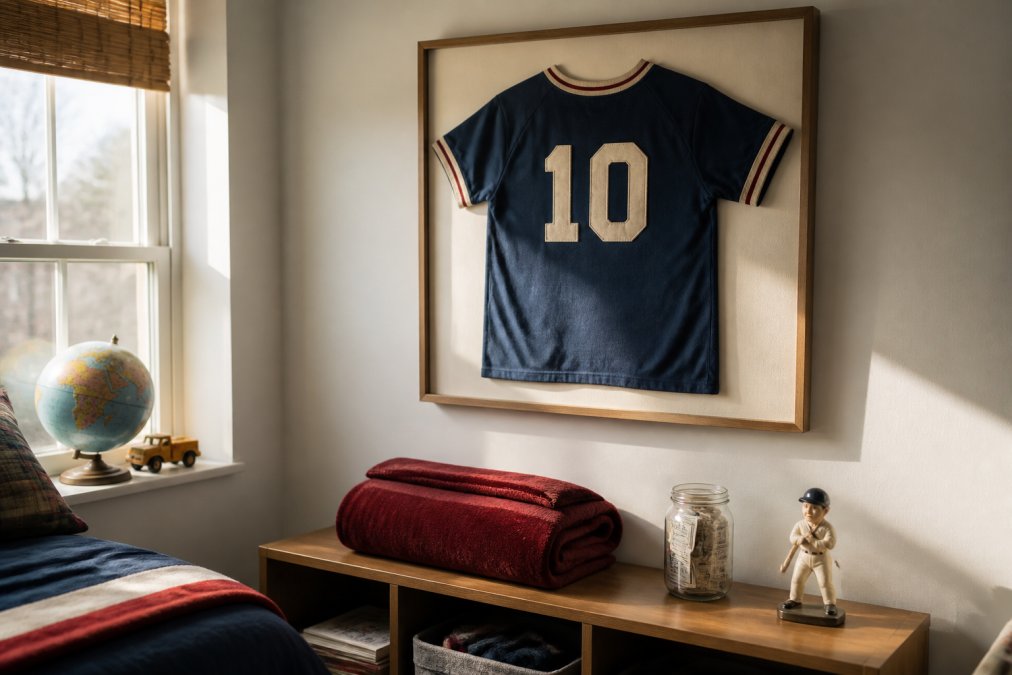
Here's a simple method that works:
- Use an acid-free backing board. Standard cardboard leaches acid over time and stains fabric.
- Mount with stainless pins or stitching, not tape. Adhesive leaves residue that won't come out.
- Keep it out of direct sunlight. UV rays fade dye fast, even through glass.
- Leave a small gap for airflow. Sealed frames trap moisture.
Creative Ways to Use Old Tickets and Small Memorabilia
Creative ways to use old tickets range from shadow boxes to coasters to a glass jar on a shelf. Group them by theme or season so they read as a collection, not clutter.
Basketball Wall Clock, Sports Clock →
A few approaches that work well:
- Shadow box: Layer tickets, a program cover, and a photo from the game.
- Memory jar: Drop stubs into a clear jar and label the year on the lid.
- Coaster set: Seal stubs under clear resin for a functional keepsake.
- Framed grid: Arrange 6-9 tickets in matching frames for a clean wall piece.
Space-Saving Storage Solutions for Athletic Gear
Space-saving storage solutions for athletic gear come down to two rules: use vertical space, and keep daily-use items within reach. Most kids' rooms have plenty of unused wall height, which is where the real storage lives.
Practical options include:
- Wall-mounted hooks for helmets, bags, and jackets
- Over-door racks for cleats and ball caps
- Under-bed bins for off-season gear
- Open shelving at kid height for balls and small equipment
- Hanging mesh bags for dirty uniforms
Safety and Sanitation Before You Repurpose Anything
Cleaning and inspecting gear before it goes in a kid's room is not optional. Old equipment can carry mold, dust mites, and bacteria, and worn materials can fail if the item becomes furniture. Most decorating guides skip this step, they show the finished shelf but not what was living on the bat.
Here's the protocol that actually works, item by item.
Fabric items: jerseys, uniforms, pads, blankets
Wash on the hottest cycle the care label allows. For synthetic mesh jerseys and polyester uniforms, that's usually warm, hot water can shrink or warp heat-pressed numbers. Add a half-cup of white vinegar to the rinse to kill odor-causing bacteria detergent alone leaves behind. Dry on low or air-dry; high heat breaks down elastic in waistbands and shoulder seams.
Hard surfaces: helmets, balls, bats, cleats
Wipe with a mild disinfectant, diluted dish soap is enough for most surfaces. Do not soak leather baseballs or softballs; the cover will separate from the core. For helmets, focus on the interior padding and chin strap, which touch skin and hair. Most manufacturers recommend replacing padding every 1-2 years of regular use, and a helmet that has taken a hard impact should never be repurposed as decor, the shell may look fine while the foam liner is compromised.
Structural integrity: the part most guides skip
Anything a child will climb on, sit on, or pull needs to hold real weight, not just look sturdy. A shelf made from a repurposed bat must carry the books on it plus a safety margin. Test any load-bearing piece with roughly double the intended weight for 24 hours before it goes on the wall.
- Wash all fabric items on the hottest cycle the label allows
- Wipe down hard surfaces with a mild disinfectant
- Discard any foam item that smells musty after cleaning
- Check for cracks, splinters, or loose hardware
- Retire any helmet that has taken a hard impact
- Confirm any mounted item is secured to a stud or anchor rated for the load
- Test load-bearing pieces with double the intended weight for 24 hours
Donating vs. Repurposing: What to Do With Outgrown Gear
Donate gear that's still usable and in good condition. Repurpose gear that's worn, broken, or holds strong sentimental value. That rule works for most families.
Use this rule of thumb:
| Condition | Best Option | Why |
|---|---|---|
| Good shape, still functional | Donate | Someone else can use it now |
| Worn but structurally sound | Repurpose as decor | Keeps the memory, avoids waste |
| Broken or unsafe | Recycle or discard | Not safe for reuse |
| High sentimental value | Repurpose or frame | Preserves the story |
Frequently Asked Questions
Is it cost-effective to use vintage sports gear for room themes?
Usually yes. A framed jersey you already own costs nothing but a frame, while a wall clock runs $54.95 and a velveteen plush blanket runs $42.95. Mixing a few purchased pieces with gear you already have keeps the total spend low, and secondhand finds at thrift stores often cost less than new mass-produced decor. The savings add up fastest when you repurpose items the family already owns instead of buying a full themed set.
How can I safely repurpose old sports equipment for a bedroom?
Wash fabric items first, then inspect for rust, splinters, sharp edges, and loose hardware. Remove or cover anything a child could pull loose. Do not hang heavy gear, such as a full equipment bag or a wooden bat rack, from drywall anchors alone; drive screws into studs or use a proper wall anchor rated for the weight. Keep small parts like laces, buckles, and ticket stubs out of reach of children under three.
What are the benefits of using repurposed items in children's decor?
Repurposed gear gives a room a story no store-bought theme can match. Kids see their own history on the wall, which supports a sense of identity and ownership over their space. It also costs less, keeps usable items out of landfills, and creates a look that will not go out of style when the next trend arrives. A repurposed sports gear display grows with your child instead of being replaced every few years.
How does upcycling sports gear promote sustainability for families?
Every item you repurpose is one less purchase and one less item in the waste stream. Youth sports generate a steady flow of outgrown cleats, pads, jerseys, and balls, and most of it is still usable. Reusing it in decor extends that life by years. It also teaches kids a practical habit: before throwing something out, ask whether it can serve a second purpose in the house.