

Table of Contents
- Gather Essential Packing Materials for Sports Memorabilia
- How to Pack Graded Cards for Shipping
- Shipping Autographed Jerseys Safely
- Best Shipping Insurance for Sports Cards and Collectibles
- USPS vs FedEx vs UPS for Collectibles
- Protecting Your Shipment with Tracking and Documentation
- How to Ship Valuable Sports Memorabilia: Complete Checklist
Last Updated: August 11, 2026
Gather Essential Packing Materials for Sports Memorabilia
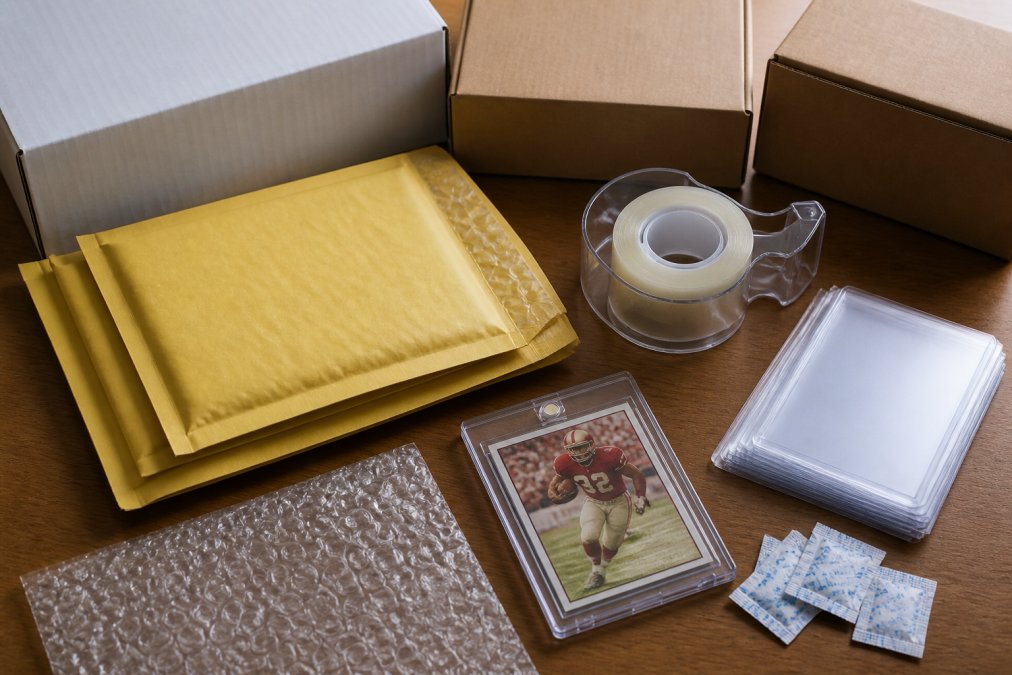
Before shipping valuable sports memorabilia, gather the right materials. A single mistake, wrong padding, insufficient protection, or poor material choice, can permanently damage items worth hundreds or thousands of dollars.
Start with penny sleeves and rigid holders for cards. Penny sleeves offer basic dust protection, while rigid holders (top loaders) firmly support cards and prevent bending. For graded cards already in slabs, the slab itself is your protective layer.
Next, gather bubble mailers and boxes. Bubble mailers work for lightweight items like single cards; for higher-value shipments or multiple items, use a flat rate or standard shipping box for better padding control.
Include silica gel packets to protect against moisture, which degrades memorabilia during transit. Wrap items individually in acid-free tissue paper before placing them in protective sleeves.
Use at least two inches of padding on all sides, bubble wrap, foam sheets, or crumpled packing paper all work. For graded cards or autographed jerseys, cardboard sandwiches (placing the item between two cardboard pieces) add extra bend protection.
Seal everything with tamper-evident tape, which shows if someone has opened the package. Use enough tape to secure all seams, at least three strips per box.
Label your package with a printed postal label and tracking information. Printed labels are scanned more reliably than hand-written addresses. Include your return address.
How to Pack Graded Cards for Shipping
Graded cards certified and encased in protective slabs by PSA or Beckett require specific handling. The slab provides substantial protection, but shipping method determines whether it arrives intact.
Confirm the card is properly secured inside the slab, it should not move or rattle. If it does, contact the grading company before shipping.
Place the slabbed card inside a team bag (a thin plastic sleeve sized for slabs) for additional dust and moisture protection. This optional step is recommended for high-value cards.
Create a cardboard sandwich by placing the slabbed card between two pieces of rigid cardboard cut to match slab dimensions. Secure with packing tape on the edges only, not across the slab face, to prevent shifting while keeping the surface accessible.
Wrap the cardboard sandwich in bubble wrap with bubbles facing inward. Secure with tape on the ends only.
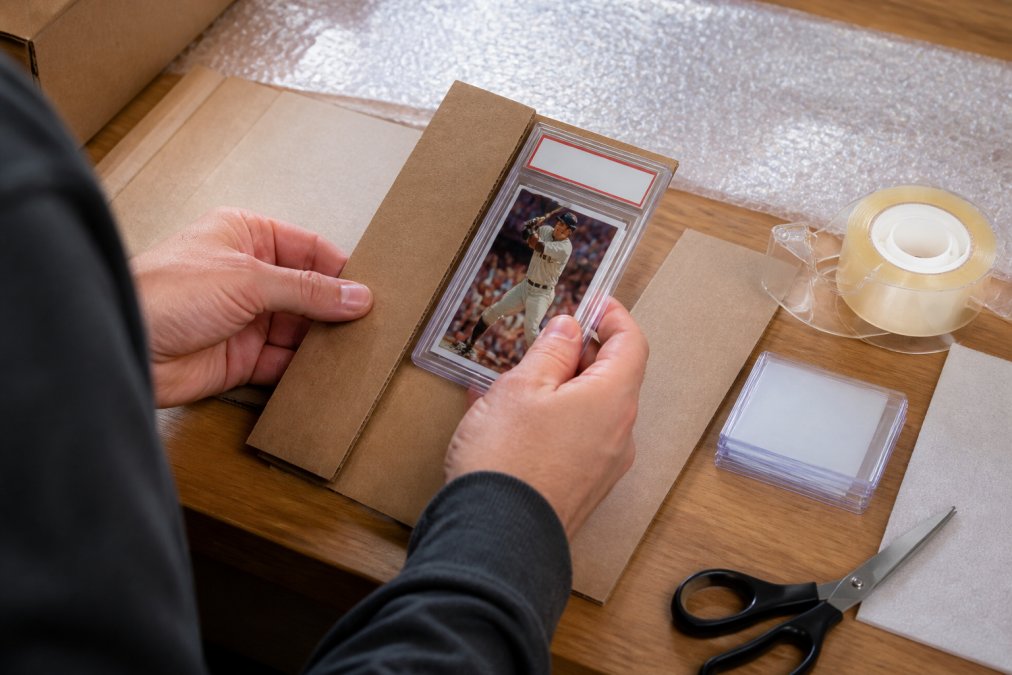
Place the wrapped card in the center of your shipping box with at least two inches of padding on all sides. Use bubble mailers only for single low-value cards under $100; for anything higher, use a box. Fill empty space with crumpled packing paper or foam peanuts.
Include a condition report inside the box. Photograph the card before shipping and print the image as reference. If a dispute arises, this digital proof protects you.
Shipping Autographed Jerseys Safely
Autographed jerseys require different protection than cards. The signature is fragile, ink can crack, fade, or transfer to packaging if exposed to moisture or friction.
Wrap the jersey in acid-free tissue paper first to prevent direct contact between the signed area and protective materials. Fold carefully so the signature faces inward, away from external pressure. Never fold directly across the signed area.
Place the wrapped jersey in a rigid box, not a soft mailer. Soft mailers compress fabric and cause creasing across the signature; rigid boxes maintain shape and protect against crushing.
Add moisture protection with silica gel packets placed inside the box away from the jersey. Include a desiccant sheet if shipping during humid months, autographed memorabilia is vulnerable to humidity damage.
Pad the jersey with crumpled packing paper or foam sheets on all sides, using at least three inches. The jersey should not move when you shake the box gently. Secure padding with tissue tape, not packing tape, to avoid adhesive residue on fabric.
Include a condition report with photographs of the jersey and signature taken before shipping. Document any existing flaws or wear.
Declare the full value on your shipping label to ensure insurance coverage matches the item's worth. For jerseys valued over $500, consider specialized sports memorabilia shipping services offering climate-controlled transport and enhanced tracking.
Best Shipping Insurance for Sports Cards and Collectibles
Shipping insurance protects your investment if the package is lost, damaged, or stolen. For valuable sports memorabilia, insurance is essential risk management.
Understand the difference between carrier liability and insurance. Most carriers provide limited liability at no extra cost, USPS Priority Mail includes up to $100 automatically. This is often insufficient for valuable items. If your $500 card is lost, standard liability covers only a fraction of your loss.
Declare the full value on your shipping label. This tells the carrier what the item is worth; the carrier then calculates appropriate insurance premium. For USPS, declaring $500 costs a few dollars extra. For FedEx or UPS, costs vary by service level and destination.
Purchase additional insurance through your carrier for items valued over $100. USPS offers insurance up to $5,000 per package; FedEx and UPS offer higher limits. Premium is typically 1-2% of declared value. For a $500 card, expect $5-10 in insurance fees.
Document everything for claims. Photograph the item before packing with close-ups of signatures, condition details, and grading slabs. Keep copies. If the package arrives damaged or missing, you'll need this documentation to file a carrier claim.
Most carriers require claims within 30 days of delivery. The carrier will investigate and either reimburse you or deny the claim.
For high-value items over $1,000, consider signature confirmation. This requires the recipient to sign, preventing unattended delivery and creating a delivery record that protects you in disputes.
USPS vs FedEx vs UPS for Collectibles
Each carrier offers different advantages for shipping valuable sports memorabilia.
USPS works well for lower-value items and standard timeframes. Priority Mail is affordable, includes tracking, and offers insurance up to $5,000. Flat rate boxes provide predictable pricing regardless of weight or distance. However, USPS handling can be rough, and Priority Mail doesn't guarantee delivery dates. For cards under $200, USPS is often most cost-effective.
FedEx excels for higher-value items and faster delivery. FedEx Ground and Home Delivery are economical for regional shipments; FedEx Express offers guaranteed overnight delivery, reducing transit time and damage exposure. FedEx provides detailed tracking, signature confirmation, and reliable insurance. However, FedEx is more expensive than USPS for standard shipments.
UPS occupies a middle ground. UPS Ground is competitive with USPS Priority Mail for regional shipments and offers excellent tracking and handling standards. Insurance is straightforward and claims are processed efficiently. For items valued between $200-$1,000, UPS often provides the best balance of cost and reliability.
Consider transit time when choosing a carrier. A $500 card shipped via slow ground spends more time in transit, increasing damage risk. Faster service (2-3 days) reduces this exposure.
For international shipping, USPS offers limited options with longer transit times (2-4 weeks). FedEx and UPS provide faster international service (5-10 days) at higher cost.
Test each carrier with a low-value item first to evaluate handling quality.
Protecting Your Shipment with Tracking and Documentation
Tracking creates accountability and provides evidence if something goes wrong.
Request a tracking number from your carrier at the point of sale. All three major carriers provide tracking automatically. Share this number with the buyer immediately after shipping.
Monitor tracking updates throughout transit. A package stalling in one location for more than 24 hours may indicate a delay or handling issue.
Signature confirmation requires the recipient to sign and prevents unattended delivery. For items valued over $300, signature confirmation is recommended.
Create a condition report before shipping:
- High-resolution photographs from multiple angles
- Close-ups of signatures, markings, or condition issues
- Photos of grading slabs showing grade and certification number
- Written description of condition, including any flaws or wear
Store documentation digitally and print a copy to include in the shipment. This protects you in disputes and claim investigations.
Include delivery instructions in the package explaining what the buyer should do upon arrival: inspect immediately for external damage, do not open inner packaging until fully inspecting the outer box, photograph any damage before opening, and contact you within 48 hours if there are issues.
How to Ship Valuable Sports Memorabilia: Complete Checklist
Use this checklist to ensure you haven't missed any critical steps before handing your package to the carrier.
| Step | Action | Details |
|---|---|---|
| 1 | Gather materials | Penny sleeves, rigid holders, bubble mailers, boxes, tape, silica gel, padding |
| 2 | Prepare item | Place card in sleeve/holder, wrap jersey in acid-free tissue, secure autographed items |
| 3 | Create cardboard sandwich | For cards: place slab between cardboard, secure edges, wrap in bubble wrap |
| 4 | Add moisture protection | Include silica gel packets, avoid direct contact with fabric or cards |
| 5 | Pad the package | 2-3 inches minimum on all sides, fill gaps with crumpled paper or foam |
| 6 | Document condition | Photograph item from multiple angles, print and include in package |
| 7 | Seal securely | Use tamper-evident tape on all seams, at least 3 strips per box |
| 8 | Create shipping label | Print clearly, use carrier's official label, include return address |
| 9 | Declare value | State full value on label, purchase insurance if needed |
| 10 | Choose carrier | USPS for items under $200, FedEx/UPS for higher values or speed |
| 11 | Request tracking | Obtain tracking number, share with buyer immediately |
| 12 | Add signature confirmation | For items over $300, require signature at delivery |
| 13 | Deliver to carrier | Hand off package, retain receipt with tracking number |
Before handing the package to the carrier, shake it gently. If you hear movement or feel shifting, add more padding. The item should be completely immobilized inside the box.
Keep your receipt from the carrier for at least 60 days after delivery. If a claim becomes necessary, you'll need this documentation.
Notify the buyer when the package ships with the tracking number and expected delivery date. Provide clear instructions on what to do upon arrival.
For items valued over $1,000, send a follow-up message a few days before expected delivery reminding the buyer to be present for signature confirmation and to inspect the package carefully.
At MoonlightWeave, we understand the value of sports memorabilia, both financial and sentimental. If you're planning to transform vintage sports items into handcrafted home goods, proper shipping is the first step in protecting those treasures. Whether you're sending a rare card, autographed jersey, or other collectible, following these shipping protocols ensures your memorabilia arrives in perfect condition. Explore our collection of vintage sports-themed accessories, like our 1961 Baseball Boston Luggage Tag, which celebrates the nostalgic value of sports history. Get started with MoonlightWeave and transform your cherished memorabilia into unique, handcrafted pieces you'll treasure for years to come.

Frequently Asked Questions
What is the safest way to ship high-value sports memorabilia?
Use a rigid holder or top loader for cards, wrap items in bubble mailer protection, add a cardboard sandwich for bend protection, and select a carrier with signature confirmation. Include declared value and shipping insurance. USPS Priority Mail Express with tracking and signature confirmation offers excellent security for items valued $500-$2,500. For items over $2,500, consider FedEx or UPS with declared value and full insurance coverage. Always request a delivery scan and keep your postal label and tracking number for claims.
How much does shipping insurance cost for sports cards?
Shipping insurance typically costs 1-3% of the declared value, depending on your carrier and coverage level. USPS insurance costs $2.45 for up to $100 coverage and increases incrementally; a $500 card might cost $6-$8 in USPS insurance. FedEx and UPS offer similar rates but often bundle insurance into declared value at no extra charge when you declare the item's market value at checkout. Always compare carrier options before shipping, as costs vary significantly.
Is it safe to ship graded cards in bubble mailers?
Bubble mailers alone are not sufficient for valuable graded cards. A slabbed card in a rigid holder or top loader provides bend protection and moisture protection that bubble mailers cannot guarantee. Use both: place the rigid holder inside a bubble mailer with padding, then use a cardboard sandwich for additional protection. This layered approach prevents bending, moisture damage, and scratches during transit. Never ship ungraded cards or slabbed cards without this multi-layer protection.
How do I file a claim if my sports memorabilia arrives damaged?
Document the damage immediately with photos and a condition report before opening the package fully. Contact your carrier within 30 days with your tracking number, postal label, and photos. Request the delivery scan records to establish proof of condition. If the carrier denies your claim, escalate through their dispute resolution process. For USPS, file a claim at your local post office; for FedEx or UPS, use their online claims portal. Keep all packaging materials and the item itself as evidence. Insurance covers loss and damage only if you declared value and selected the appropriate coverage level.
This article was written using GrandRanker