

Table of Contents
- Start with a Sorting Workflow for a Large Unsorted Collection
- Choose Your Organization System: Set, Player, Team, or Year
- How to Catalog a Baseball Card Collection with an Inventory Spreadsheet
- Organize Baseball Cards by Year and Set for Faster Lookups
- The Best Supplies for Storing Baseball Cards Long Term
- Triage by Condition and Value: What Stays, What Sells, What Goes
- Labeling Boxes, Binders, and Dividers So You Can Find Any Card
- Frequently Asked Questions
Last Updated: October 6, 2026
Start with a Sorting Workflow for a Large Unsorted Collection
The best way to learn how to organize large vintage baseball card collections is to sort in passes, not all at once. Three quick passes, done in batches, beat one marathon session every time.
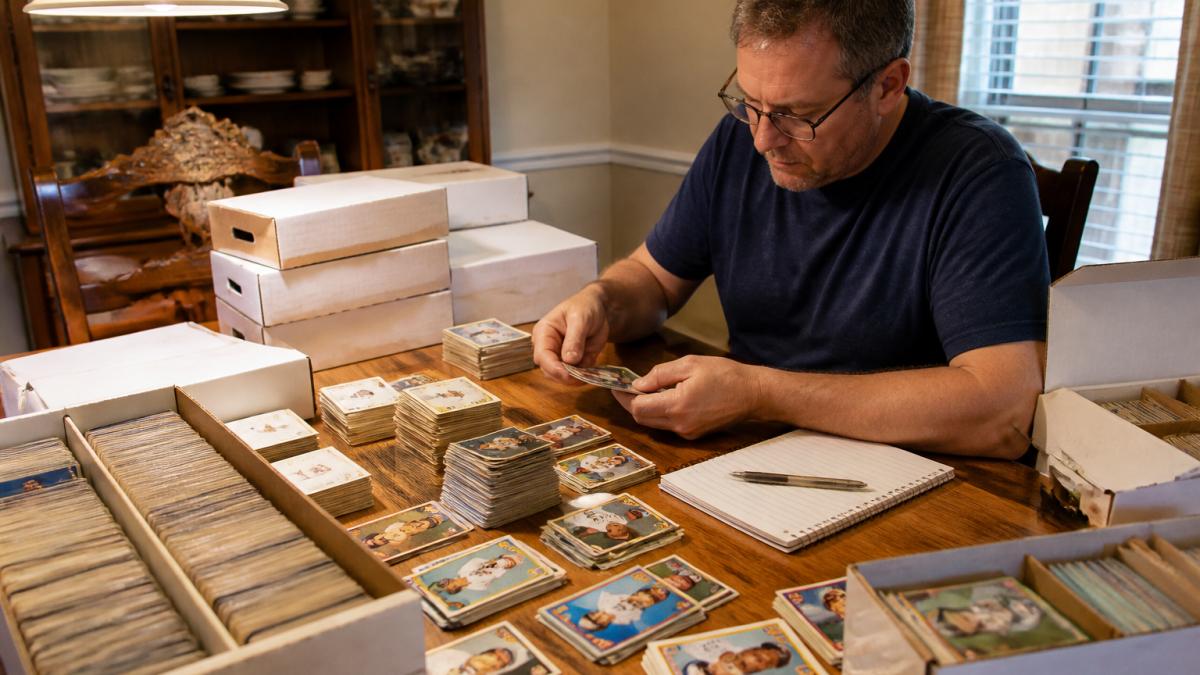
Start by clearing a big table. Divide it into three zones with masking tape or scrap paper: Keep, Review, and Bulk.
Set Up Three Zones: Keep, Review, Bulk
Every card you touch goes into one of three piles:
- Keep: stars, rookies, and anything you want to display or protect
- Review: cards you're unsure about, including possible condition issues
- Bulk: commons and duplicates headed for storage boxes
Don't stop to price anything. Speed matters more than precision in this pass.
Work in Batches of 100 to 200 Cards
Large collections overwhelm people because they try to finish in one sitting. They don't.
Work in batches of 100 to 200 cards. Finish a batch, stack it, and label it. Then take a break. A common mistake is mixing decades together, which doubles your work later.
Choose Your Organization System: Set, Player, Team, or Year
Pick one primary system for how to organize large vintage baseball card collections before you touch a single binder. Most collectors default to sets, but that's not always right.
Here's how to choose:
| System | Best For | Watch Out For |
|---|---|---|
| Set | Completing runs, vintage sets | Slow if sets are incomplete |
| Player | Star-focused collections | Duplicates pile up fast |
| Team | Team collectors, display pieces | Cross-team trades confuse it |
| Year | Big mixed collections | Weak for set builders |
For vintage cards, set-based organization usually wins. It matches how the hobby values cards and makes set completion possible later. But if your collection is mostly stars from many teams, player or team sorting will serve you better.
How to Catalog a Baseball Card Collection with an Inventory Spreadsheet
To catalog a baseball card collection, log each card in a spreadsheet with consistent fields. This turns a pile of cardboard into a searchable inventory. It also protects you if you ever insure or sell the collection.
Start with a free template in Google Sheets or Excel. Add rows as you go, not after.
Fields Every Baseball Card Inventory Spreadsheet Template Needs
A good template includes these columns:
- Year and set name
- Card number
- Player name and team
Add a "notes" column for oddities like printing errors or trimmed edges. It saves you a second look later.
Organize Baseball Cards by Year and Set for Faster Lookups
Filing cards by year and set makes lookups fast and set completion possible. Group by year first, then by set within each year. Within a set, sort by card number.
But vintage cards don't always announce themselves the way modern ones do. Before you can file a card by year and set, you often have to identify it. That identification step is where most large vintage projects stall, so build it into your workflow instead of treating it as a separate chore.
Identify the Year, Manufacturer, and Set Before You File
Modern cards print the year, brand, and set name right on the front. Vintage cards frequently don't. A card may show only a player photo, a team name, and a facsimile signature. Use these cues in order:
- Back design and text: The card back usually carries the manufacturer name (Topps, Bowman, Fleer, Goudey, and others) plus a copyright line or set identifier. The back layout is often the fastest way to separate similar-looking sets from the same year.
- Card number and checklist: Many vintage sets number cards and print a checklist on the back or on a dedicated checklist card. The number plus the checklist confirms the set.
- Player/team combination: A player shown with a team he only played for in a narrow window narrows the year fast. Rookie cards and traded/updated cards are especially useful anchors.
When two sets from the same year look alike, note the manufacturer on the divider tab, not just the year. "1968 Topps" and "1968 Topps Game" are different sets with different checklists, and mixing them creates phantom gaps.
Watch for Reprints, Recollections, and Counterfeits
Large vintage collections almost always contain some reprints. Common giveaways include:
- Too-white stock or glossy finish on a card that should have a matte, aged surface
- Sharp corners and bright color on a card that should show decades of wear
- A back that doesn't match the front's era, modern copyright text, different paper, or a reprint disclaimer
Set reprints aside in a separate "verify" pile. Don't file them into your main run until you've confirmed them, or you'll contaminate a set with cards that don't belong.
Close Checklist Gaps Deliberately
Once a set is sorted by card number, walk the checklist and mark every missing number. Keep a running want list per set. This turns set completion from a vague goal into a shopping list, and it prevents you from buying duplicates you already own. For vintage sets, note the key cards (stars, rookies, short prints) on the same list so you know which gaps are worth paying up for and which are commons you can fill cheaply.
Label each group with a divider. Write the year, manufacturer, and set name on the tab. For vintage sets, the manufacturer matters as much as the year, because similar sets from the same season can look nearly identical at a glance.
The Best Supplies for Storing Baseball Cards Long Term
The best supplies for storing baseball cards long term are acid-free boxes, penny sleeves, and rigid holders for anything valuable. Cardboard and plastic both break down over time, and old cards are more fragile than modern ones.
Here's what to buy:
- Acid-free storage boxes: the foundation for bulk cards
- Penny sleeves: cheap protection for every card worth keeping
- Top loaders and rigid holders: for stars and high-value cards
Avoid anything labeled "PVC" or stored in a hot garage. Heat and moisture do more damage than handling.
Triage by Condition and Value: What Stays, What Sells, What Goes
Not every card deserves the same treatment, and you cannot afford to research every card in a large vintage collection. Triage by condition and value so your best cards get the best protection and your time goes where it pays off.
The goal is a fast, repeatable filter, not a full appraisal. You are sorting cards into handling tiers, not pricing them.
Use a Condition Scale You Can Apply in Seconds
Professional grading uses a 1-10 scale, and most collectors are familiar with the shorthand: a card graded 8 or higher is considered high grade, 4 to 7 is mid-grade, and 3 and below is low grade. You don't need to grade cards yourself, but you do need a quick internal scale. A practical vintage triage scale:
- Tier A (send for grading or appraisal): sharp corners, clean surface, centered image, no creases, no writing, no trimming. These are the cards where professional grading can meaningfully change value.
- Tier B (protect, don't grade yet): minor corner wear, light surface issues, but no major creases or alterations. Sleeve and store these well; revisit later.
- Tier C (bulk): heavy creases, rounded corners, writing, stains, missing corners, or obvious trimming. These go into bulk storage sorted by year and set.
Check the back as carefully as the front. Vintage cards are commonly found with paper loss, glue residue, tape stains, or pencil marks on the back, all of which drop a card a tier or more.
Flag, Don't Research
The biggest time sink in a large collection is stopping to look up every card. Don't. Instead, flag cards for later research using a simple rule:
- Is it a star, rookie, or short print? If yes, it gets a flag regardless of condition.
- Is the condition Tier A or high Tier B? If yes, it gets a flag.
- Is it a known key card in its set? If yes, it gets a flag.
A card that hits any one of these goes into a "research later" pile with a sticky note or a slip of paper identifying the set and card number. Everything else moves straight to bulk. This keeps your sort moving and concentrates your research time on the small percentage of cards where it matters.
Know When Professional Grading Is Worth It
Professional grading (through services like PSA, SGC, or Beckett) costs money per card and takes time, so it only makes sense when the potential value increase exceeds the cost and hassle. As a rule of thumb, grading is worth considering when a card is Tier A condition and is a known key card, star, or rookie. For low-grade commons, grading almost never pays for itself.
Separate Handling Tiers Physically
Once triaged, keep the tiers physically separate so you don't accidentally store a Tier A card in a bulk box:
- Tier A: rigid holders (top loaders or card savers), stored upright in a dedicated box, away from light and heat.
- Tier B: penny sleeves plus semi-rigid holders or binder pages, stored in a cool, dry location.
- Tier C: bulk boxes, sorted by year and set, with a label noting the tier so you don't re-sort later.
Revisit your flagged pile in batches, say, once a week or once a box is finished, rather than card by card. That keeps the project moving and keeps your research sessions focused.
Labeling Boxes, Binders, and Dividers So You Can Find Any Card
A labeled collection is a usable collection. Write labels on box lids, binder spines, and divider tabs with the same format every time.
Use this pattern:
- Box lids: Year range, set name, card number range
- Binder spines: Set name, year, and volume number
- Dividers: Player, team, or card number range
Use a label maker or fine-tip marker. Pencil smudges; tape peels. If you have multiple boxes for one set, add "Box 1 of 3" so you don't lose track.
Once your collection is sorted, stored, and labeled, the cards you love most deserve a second life. At MoonlightWeave, we turn vintage memorabilia into handcrafted fabric goods and home accessories, from cozy blankets to luggage tags and doormats.
Frequently Asked Questions
What is the best way to organize a large vintage baseball card collection?
Sort first, then decide on a system. Pull high-value and vintage cards into penny sleeves and top loaders, keep commons in bulk storage boxes, and file selected cards into binders with pocket pages. Organize vintage baseball cards by year and set once you have completed the initial triage, then build an inventory spreadsheet so you can track what you own and find any card without digging through boxes.
How do you identify the year and set of an old baseball card?
Check the back of the card for a copyright line, a set number, and the manufacturer name. Set numbers and design details usually point to a specific year and brand. When the back is unclear, compare the card against a printed checklist or a set database for that era. Write the year and set number directly on the divider or inventory row as soon as you confirm it, before the card goes back into storage.
What supplies do you need to organize vintage baseball cards safely?
You need acid-free penny sleeves, rigid top loaders for anything valuable, 3-ring binders with acid-free pocket pages, cardboard storage boxes sized for cards, and dividers for sections. For older cards, avoid PVC pages and any storage that traps moisture. Keep boxes off concrete floors and out of attics or basements where humidity swings. Label each box, binder spine, and divider so the system stays usable months later.
How should you store vintage baseball cards to protect their condition?
Store cards upright in acid-free boxes or binders, in a room with stable temperature and low humidity. Use penny sleeves for every card and rigid holders for high-value ones. Keep boxes off the floor and away from exterior walls. Sunlight fades ink, so store binders and boxes in the dark. Check the collection once a year for moisture, pests, or warping, and re-sleeve anything that shows signs of damage.
Old collections don't organize themselves, and waiting another season only makes the cardboard more fragile. MoonlightWeave turns the memorabilia you love into handcrafted blankets, luggage tags, and home decor you'll actually use. Our pieces are made for sports fans who want nostalgia in everyday life, not just in a storage box. Continue shopping with MoonlightWeave and give your favorite cards and jerseys a second life.