

Last Updated: October 30, 2026
Quick Summary
To display vintage boxing gloves at home, first check the leather for cracks, dryness, and loose stitching, then choose a sealed or UV-filtering case, stand, or wall mount that supports the glove without pressing on weak spots. Keep it away from direct sun, heat, and humidity, and handle it only with clean, dry hands. If the leather is already cracking or moldy, get a conservator's assessment before displaying it.
- Check leather, stitching, laces, padding and any signatures before choosing a display.
- A sealed case with a UV-filtering front suits fragile or powdery leather best.
- Leave at least an inch of clearance on each side and two inches in front of the glove.
- Never clean, oil, or condition vintage leather before displaying it.
- Use acid-free tissue, not plastic bags or wrap, to store gloves that are not on display.
Table of Contents
- Choose the Right Display Option for Your Space
- How to Preserve Vintage Boxing Gloves Before You Display Them
- Step-by-Step: How to Mount a Boxing Glove on the Wall
- Supporting a Single Glove Without Stressing the Leather
- Placement, Lighting and Protection From Dust and Sunlight
- Setting Up Your Boxing Glove Display This Weekend
- Frequently Asked Questions
Vintage boxing gloves are fragile, and the right way to display vintage boxing gloves starts with knowing what you have.
Before you touch a glove, look closely for cracks, dry patches, flaking laces and loose stitching.
Here is a quick checklist to run through:
- Leather: Is it soft and supple, or cracked and dry?
- Stitching: Are seams intact, or coming apart?
- Laces and straps: Are they brittle or still flexible?
A glove in good shape can handle a simple shelf or closed case.
Watch out: Never clean or oil vintage leather before you display it.
Choose the Right Display Option for Your Space
Your room and your glove both matter, but the glove should drive the decision. A busy hallway calls for something sturdy and enclosed; a quiet den suits a more delicate piece. Four variables decide it: leather condition, light and dust exposure, kids or pets nearby, and how often you want to see the glove.
Ask yourself these questions before you buy anything:
- Is the leather stable, or cracked, powdery, or flaking?
- How much direct sun and dust does the spot get?
- Are kids or pets nearby?
- Do you want to see the glove daily or only on special occasions?
- How much wall or shelf space can you give up?
Your answers point you to the right option. Most people end up choosing between a sealed case, a stand, or a wall mount, and each has real trade-offs.
Display-Case Trade-Offs: Acrylic vs. Glass, Sealed vs. Ventilated
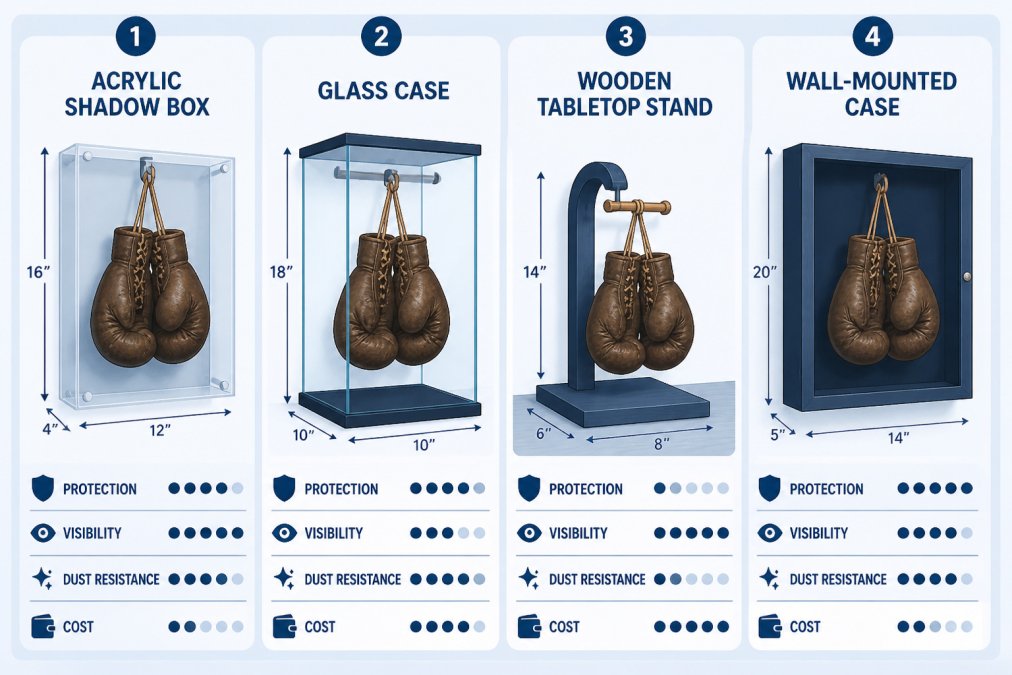
A shadow box or clear case is the safest choice to display vintage boxing gloves: it keeps dust off, blocks some light, and stops fingers from touching the leather. But not all cases are equal.
- Acrylic is lighter and less likely to shatter, but it scratches easily and can build up static that attracts dust. It also yellows over time under strong UV.
- Glass is more scratch-resistant and optically clearer, but it is heavier, needs sturdier mounting hardware, and can break if knocked.
- Sealed cases keep dust and insects out but can trap moisture if the glove goes in damp. Only seal a glove that is fully dry and stable.
Look for a case with a UV-filtering front and a back that closes well. Make sure the inside is deep enough so the glove does not press against the glass.
The trade-off is that a closed case hides the glove and must be opened to clean or adjust the piece, so plan for that.
Stands and Tabletop Displays
A stand works well when you want the glove visible and easy to move. Wood and metal stands are common, and a padded form can hold the glove's shape without squeezing it.
Pick a stand with a wide, padded base and avoid thin wire arms that bend the glove or pull on the laces. Keep it away from edges, heaters, and direct sun.
Wall-Mounted Displays
A wall mount saves shelf space and keeps the glove at eye level, but it stresses the hardware and the glove's seams most. Use a mount that supports the glove from below and behind rather than hanging it from the cuff or laces. Wall mounts suit stable gloves; for fragile leather, a wall-mounted case is safer because it distributes weight across a back panel.
Choosing by Glove Size and Condition
A modern 16 oz training glove is bulky and needs a case at least 14 inches tall and 8 inches deep. A vintage 8 oz or 10 oz glove is smaller but often more fragile, so give it more clearance, not less. If the glove is cracked or the padding has collapsed, choose a case with a padded back and a form that cradles the palm rather than a stand that lets the fingers hang free.
How to Preserve Vintage Boxing Gloves Before You Display Them
Preservation starts before the glove leaves its box and matters most for genuinely old leather. Your goal is to keep the leather stable and stop it drying out, cracking, or growing mold. Stable temperature and moderate humidity do more for old leather than any product.
Limit Light, Heat, and Humidity
Ultraviolet light fades dye and breaks down leather fibers, and heat dries the oils that keep leather supple. Keep the glove out of direct sun and away from radiators, heat vents, and fireplaces. High humidity encourages mold; very dry air encourages cracking. A room that stays comfortable for people is usually kind to leather too.
Handle With Clean, Dry Hands
Oils and salts from your hands transfer to leather and can darken it or leave marks that cannot be removed. Wash and dry your hands before touching the glove, or wear clean cotton gloves. Support it with both hands, and never lift it by the laces, cuff, or a single finger.
Dust Gently, Never Scrub
Use a soft, dry brush or a microfiber cloth. Work from the seams outward, and stop if the leather starts to flake. Never use water, saddle soap, or leather conditioners on vintage gloves unless a conservator has approved the product for that specific piece. Many common leather products darken old gloves or strip their finish.
Support the Glove Without Stressing It
Old gloves need support that cradles the palm and back rather than squeezing the sides. Padded forms distribute weight across the glove, while tight fits, adhesives, pins, and pressure on seams cause new damage. Make sure any form is slightly smaller than the glove's interior so the leather is supported, not stretched. Avoid clips or pins that pinch the leather, and never use tape, glue, or adhesive hooks on vintage leather.
Store Flat or Upright Before Display
If the glove is not going on display right away, store it flat or upright so no part hangs off a shelf edge. Support the weight with acid-free tissue, and check it monthly for new cracks or musty smells.
What to Do If Leather Is Cracked, Moldy, or Deteriorating
- Cracked or powdery leather: Stop handling it more than necessary, keep it out of light and dry air, and consider a sealed case with a UV-filtering front. Do not oil it yourself.
- Mold or musty smell: Isolate the glove from other items, improve air circulation, and consult a conservator before displaying it. Mold can spread and permanently damage leather.
- Flaking or crumbling: This signals active deterioration. A conservator should assess the glove before you mount or case it, because the wrong support can accelerate the damage.
When to Call a Conservator
If the leather is cracked, moldy, flaking, or actively deteriorating, have a conservator assess it before display. A conservator can stabilize fragile leather, recommend safe support, and advise whether a sealed or ventilated case suits that piece. For gloves with signatures or historic marks, they can also advise on whether the ink is stable enough to display.
American Institute for Conservation, finding a conservator
Care Before and After Display
Before the glove goes into its case or onto its stand, dust it gently, check for new cracks, and let it acclimate to the room for a day or two. After display, check it monthly for dust, new cracks, or musty smells, and dust the case or stand every few weeks with a soft cloth. Keep notes on the date, display type, and placement so you can spot changes over time.
Step-by-Step: How to Mount a Boxing Glove on the Wall
Mounting a glove on the wall looks simple, but a few details make the difference between a secure display and a slow slide toward the floor.
Before you start, gather a stud finder, a level, a drill, anchors rated for your glove's weight, and a soft cloth to protect the leather.
- Find a solid spot. Locate wall studs and avoid placing the mount on drywall alone.
- Measure the glove. Note its height, width and depth so you can plan the spacing.
- Mark your holes. Use the level to keep the mount straight.
- Drill and insert anchors. Use the anchor size recommended for your wall type.
- Attach the mount. Tighten it firmly, then test it with light pressure.
- Hang the glove. Set it on the mount with a cloth between the leather and the metal.
- Step back and check. Make sure the glove sits level and does not sag.
Here is a quick reference for the mounting step:
| Step | Tool needed | Common mistake |
|---|---|---|
| Find studs | Stud finder | Skipping this and using drywall only |
| Mark holes | Level, pencil | Crooked mount |
| Install anchors | Drill, anchors | Anchors too small for the weight |
| Hang glove | Soft cloth | Metal touching leather directly |
Vintage gloves are heavier and more fragile than modern ones, so give the mount more room than you think you need.
Supporting a Single Glove Without Stressing the Leather
Single gloves need careful support.
Use a stand or mold that cradles the glove across its palm and back.
If you have a pair, display them with the gloves slightly apart so they do not press into each other.
Watch out: Never use tape, glue or adhesive hooks on vintage leather. They can lift the finish and leave marks that cannot be removed.
Placement, Lighting and Protection From Dust and Sunlight
Where you place the display matters as much as the display itself. Sunlight fades and dries leather, and dust settles into seams and laces.
Keep the glove away from windows with strong direct sun. If your only wall gets sun, use a case with UV-filtering glass.
Keep the display out of humid areas like bathrooms and kitchens. Stable indoor air is the goal.
Setting Up Your Boxing Glove Display This Weekend
You can finish a solid display in one weekend.
On Saturday, inspect the glove, choose your display type, and buy the case, stand or mount.
On Sunday, clean the area, dust the glove gently, and install the mount or set the stand.
Keep notes on the date, the display type and the placement. Those notes help you spot changes over time.
Frequently Asked Questions
What are some creative ways to display vintage boxing gloves?
Vintage boxing gloves work well in several settings: a wall-mounted shadow box above a desk, a clear acrylic case on a bookshelf, a wood stand on a mantel, or a pair hung by their laces from a sturdy hook in a den or game room. Choose the option that keeps the leather away from direct sunlight and high-traffic areas, and pick a display that suits the glove's size and weight. Pairing gloves with a signed photo or a championship program adds context and makes the display a conversation piece for guests.
Should vintage boxing gloves be kept in a display case?
A display case is the safest choice for genuinely vintage leather because it blocks dust, limits handling and reduces exposure to humidity swings. An acrylic case with a sealed back protects against dust and accidental bumps, while an open wall mount is more exposed. If you hang gloves openly, keep them out of direct sunlight, away from radiators and out of rooms with high humidity. Any display should avoid pressure points that could crack aged leather over time.
How do you hang boxing gloves without damaging them?
Use a support that holds the glove at its natural shape rather than a single thin hook through the laces or cuff, which can stress the stitching. A padded mount or a custom glove mold distributes weight evenly. Avoid adhesives, tape and tight straps directly on the leather. Check the mounting hardware before you hang the glove, make sure it is anchored into a stud or a rated anchor, and inspect the glove every few months for cracking or loosening stitches.
How can you protect vintage boxing gloves from dust and sunlight?
Keep vintage gloves out of direct sunlight because UV light fades and dries leather. Place the display away from windows or use a case with UV-filtering acrylic. Dust settles quickly on exposed leather, so a sealed case or a periodic gentle wipe with a soft dry cloth helps. Store any spare gloves in a breathable cotton bag or acid-free box rather than plastic, which can trap moisture and promote mildew.
