

Table of Contents
- Understanding Stick Flex and Body Weight
- Hockey Stick Flex Chart for Beginners
- How to Measure Hockey Stick Length
- Hockey Stick Blade Patterns Explained
- Material Composition: Composite vs. Wood
- Kick Point and Stick Lie for Beginners
- Ice Hockey vs. Field Hockey Sticks
- Budget-to-Performance Ratio and Durability
- Frequently Asked Questions
Last Updated: September 28, 2026
Understanding Stick Flex and Body Weight
Stick flex is the measurement of how much a hockey stick bends under pressure. It's expressed as a number (typically 40 to 110 for ice hockey) that indicates the force required to flex the shaft one inch. A lower number means the stick bends more easily; a higher number means it requires more force to flex.
Your body weight is the primary factor determining which flex you need. The general rule: your flex rating should roughly match your body weight in pounds. A 150-pound player performs best with a 150-flex stick. A 200-pound player needs around 200-flex. This isn't arbitrary, when your flex matches your weight, you generate maximum power transfer from your legs through the stick to the puck.
When learning how to choose the right hockey stick for beginners, many make the mistake of choosing too stiff a stick. They assume more stiffness equals more control, but the opposite happens. An overly stiff stick requires more effort to flex, making it harder to shoot accurately and reducing shot power. You won't bend it enough to release the energy properly. A stick that's too flexible, meanwhile, feels mushy and unpredictable, you can't trust where the puck will go.
The sweet spot exists where the stick naturally matches your physical capability. When you load the stick during a shot, it should bend smoothly and snap back with authority. This creates the whip effect that generates both speed and accuracy. Most beginners see immediate improvement in shot consistency once they switch to the correct flex.
Hockey Stick Flex Chart for Beginners
Here's a practical reference for selecting flex based on body weight:
| Body Weight Range | Recommended Flex | Playing Style | Notes |
|---|---|---|---|
| Under 120 lbs | 50-70 | Youth/light build | Easier to load and shoot |
| 120-160 lbs | 70-85 | Beginner/average | Most common range |
| 160-200 lbs | 85-100 | Average to strong | Balanced power and control |
| 200+ lbs | 100-110 | Strong/power player | Maximum stiffness for heavy players |
These ranges account for typical beginner skill levels. As you improve and develop stronger shot technique, you might prefer a slightly stiffer stick than your weight suggests. Elite players often use flex one or two points higher than their body weight because they have the technique to load the stick fully.
Age also matters for youth players. A 12-year-old weighing 100 pounds shouldn't use a stick rated for 100-flex just because of the number. Youth sticks come in shorter lengths with proportionally lower flex ratings designed for developing bodies. The flex chart above assumes adult-length sticks.
One critical detail: flex rating assumes you're using the stick at its full length. If you cut down a stick, you effectively increase its flex. A 100-flex stick cut 2 inches shorter plays closer to 105-flex. This matters if you're modifying equipment.
How to Measure Hockey Stick Length
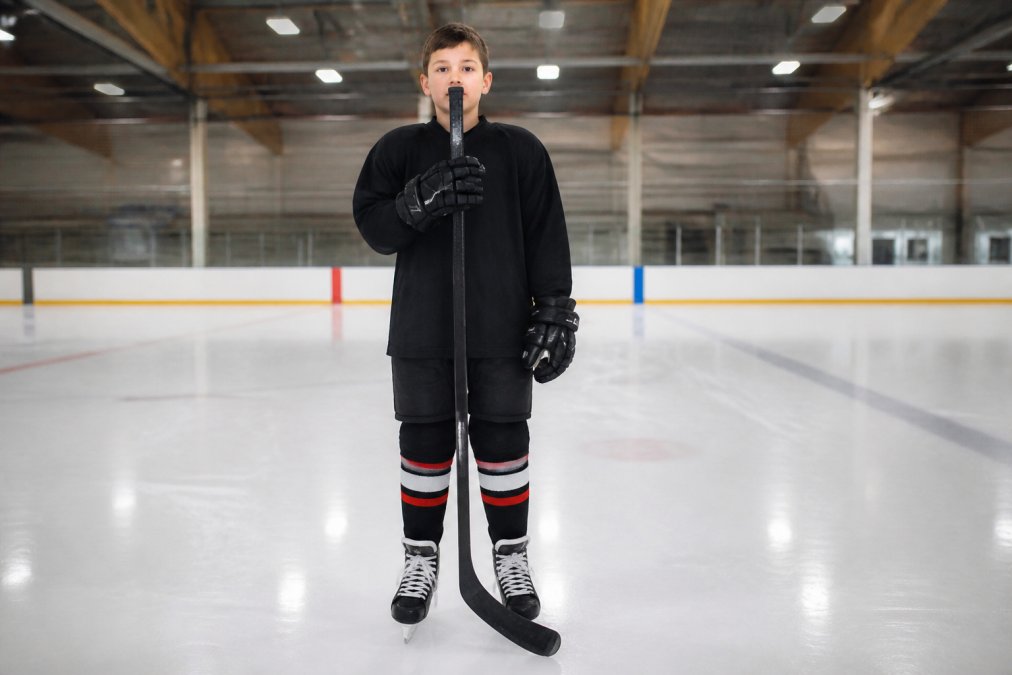
The correct hockey stick length reaches somewhere between your chin and your nose when you're standing in your skates on the ice. This is the standard measurement used across the sport. Without skates, measure from the floor to approximately chin height.
For beginners, aim for the longer end of this range, closer to your chin than your nose. A slightly longer stick gives you better reach and use, which helps with learning proper technique. As you develop, you might prefer a shorter stick for improved maneuverability, but starting longer is safer.
The measurement process is straightforward. Put on your skates, stand naturally, and hold the stick vertically with the blade flat on the ice. Look straight ahead. The top of the stick should align with your chin or just below it. If it reaches your nose, it's too long. If it barely reaches your mouth, it's too short.
Length affects more than just reach. A longer stick creates a longer lever arm, which means more power but less control. A shorter stick is more responsive and easier to handle in tight spaces. For beginners learning basic skills, the extra reach of a longer stick outweighs the control trade-off.
Hockey Stick Blade Patterns Explained
The blade curve, also called the blade pattern, describes how much the blade is bent or curved along its length. This affects puck handling, shot accuracy, and passing. Common blade patterns range from straight to highly curved.
A straight blade (minimal curve) provides maximum control and accuracy. The puck sits flat on the blade, making it easier to position for passes and shots. Beginners often prefer straight or very slight curves because the learning curve is gentler.
A mid-curve blade (moderate curve) bends slightly along the length of the blade. This curve helps with puck control during stick-handling and adds a natural snap to shots. Most players use mid-curve patterns because they balance control with power.
A heel curve bends upward at the heel (the bottom of the stick). This pattern helps players who prefer keeping the puck closer to their body during stick-handling. It's popular among forwards who need quick hands.
A toe curve bends upward at the toe (the top of the blade). This pattern aids in lifting the puck for shots and passes. Players shooting a lot use toe curves because the natural curve of the blade helps elevate the puck.
The blade pattern also includes the lie, which is the angle where the blade meets the shaft. A lie of 4 or 5 is standard for most players. A lower lie (4) means the blade is more upright; a higher lie (6 or 7) means it's more angled. Your stance and height determine the best lie. If you play with your stick more upright, a lower lie works better. If you play with the stick more angled, a higher lie suits you.
Material Composition: Composite vs. Wood
Modern hockey sticks come in two main categories: composite and wood. Understanding the differences helps you make an informed choice based on budget and performance needs.
Composite sticks are made from materials like fiberglass, carbon fiber, and aramid (Kevlar). These materials are layered together to create a shaft with specific performance characteristics. Composite sticks are lighter, more durable, and more consistent in performance. They maintain their flex rating longer and perform better in cold conditions. The downside: they cost significantly more than wood.
Wood sticks are solid wood, typically ash or birch, sometimes with a thin composite overlay. They're heavier and less durable than composite sticks. The flex rating can change over time as the wood ages and becomes brittle. They're also more affected by temperature and humidity. The advantage: wood sticks cost less upfront, making them ideal for beginners still learning whether they'll stick with hockey.
For beginners, a wood stick or a lower-end composite is sensible. You're still developing your technique and don't yet know your long-term commitment to the sport. A quality wood stick performs adequately for learning fundamentals. As you improve and play more frequently, upgrading to a composite stick becomes worthwhile.
The construction method also matters. One-piece construction means the shaft and blade are molded as a single unit. This creates a consistent flex curve and better energy transfer. Two-piece construction has a separate blade attached to the shaft. Two-piece sticks are often cheaper and allow you to replace just the blade if it breaks, but they can be less responsive.
Kick Point and Stick Lie for Beginners
The kick point is where the stick bends most when you load it during a shot. This determines how the stick releases energy and affects shot characteristics.
A low kick point (near the blade) bends closer to the puck. This creates a quicker release and is ideal for snap shots and wrist shots. Players who take frequent shots prefer low kick points because the stick snaps back faster.
A mid-kick point (middle of the shaft) provides a balanced release. It works well for all shot types and is the most forgiving for beginners. You get reasonable power and decent release speed without needing perfect technique.
A high kick point (near the top of the shaft) bends higher up. This creates more of a catapult effect and generates maximum power for slap shots. Power players and defensemen often prefer high kick points.
For beginners, a mid-kick stick is the safest choice. It doesn't require perfect timing or technique to generate decent shots. As you develop your shot technique, you can experiment with different kick points to match your playing style.
The stick lie is the angle between the blade and the shaft. Standard lies range from 4 to 7. A lie of 4 or 5 is most common. Your stance determines the right lie. If you stand more upright, use a lower lie (4 or 5). If you crouch lower and angle the stick more, use a higher lie (6 or 7).
Incorrect lie causes problems.
Ice Hockey vs. Field Hockey Sticks
Ice hockey and field hockey sticks look similar but are engineered for completely different sports. Understanding the differences prevents buying the wrong stick.
Budget-to-Performance Ratio and Durability
Beginner sticks don't need to be expensive. A solid wood or entry-level composite stick performs adequately for learning. The performance difference between a $80 stick and a $200 stick matters less when you're still developing basic skills.
Frequently Asked Questions
What stick flex should a beginner hockey player use?
Most beginners benefit from a flex rating between 50 and 70, depending on body weight. Lower flex (50-60) allows easier shot release and is more forgiving for developing players.
How do I know if my hockey stick length is correct?
When standing in skates with the stick on the ice, the top of the shaft should reach between your chin and nose. Off-ice, stand in regular shoes and the stick should reach your chin. A stick that's too long reduces accuracy and puck control; too short limits your reach and shot power.
What's the difference between ice hockey and field hockey sticks?
Ice hockey sticks are designed for smooth frozen surfaces and have a curved blade optimized for shooting and passing on ice. Field hockey sticks are straighter and designed for grass or artificial turf, with a different blade angle and weight distribution. They're not interchangeable, using the wrong type affects your control, shot accuracy, and overall performance.
Should a beginner buy a composite or wood hockey stick?
Composite sticks offer better performance, consistency, and durability but cost more upfront. Wood sticks are cheaper and forgiving for beginners developing their technique, though they wear faster. Many beginners start with a mid-range composite stick to balance cost and performance.