

Table of Contents
- Custom Doormats vs Standard Store-Bought Mats: A Side-by-Side Comparison
- Durable Outdoor Doormat Materials
- How to Choose a Front Door Mat for Your Space
- Personalized Welcome Mats for Home: Design and Branding Potential
- Durability, Weather Resistance, and Slip Resistance Compared
- Cost, Maintenance, and Long-Term ROI
- Verdict: Which Doormat Wins for Your Entryway?
- Frequently Asked Questions
Last Updated: September 20, 2026
Custom Doormats vs Standard Store-Bought Mats: A Side-by-Side Comparison
Custom doormats are entry mats made to a specific design rather than pulled off a shelf. They differ from store-bought mats in material quality, lifespan, and how well they match your home.
Store-bought mats win on price and convenience; custom doormats win on durability, fit, and uniqueness.
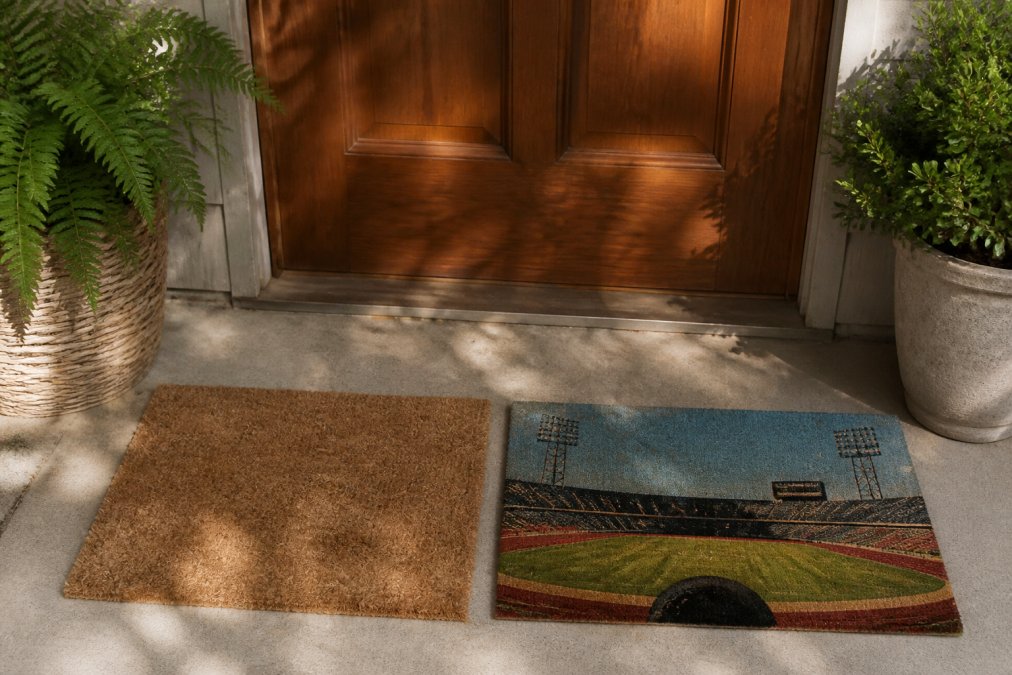
Quick Comparison Table
| Factor | Custom Doormats | Standard Store-Bought Mats |
|---|---|---|
| Material quality | Grade-A coir, dense fibers | Mixed fibers, thinner weave |
| Size options | Standard size | Fixed standard sizes |
| Design | Personalized branding, custom typography | Generic prints |
| Upfront cost | Higher | Lower |
| Lifespan | Longer with basic care | Shorter, replaced often |
| Slip resistance | Often includes non-slip backing | Varies widely |
| Best for | Front entries with character | Rentals, quick fixes |
Durable Outdoor Doormat Materials
Material decides how a mat performs, not the price tag. Coir fiber dominates outdoor entry mats.
Coir comes from coconut husks and forms stiff, coarse bristles that scrape mud and grit off shoes. Coir mats typically run a pile height of roughly 0.5 to 0.75 inches with a face weight of 16 to 22 oz. The bristles dry quickly in a covered area, so coir works best under an overhang or portico rather than in open rain.
Coir vs Nylon vs PET Recycled Materials
| Fiber | Scraping Power | Moisture | Typical Pile Height | Typical Face Weight | Best Placement |
|---|---|---|---|---|---|
| Coir | High | Dries fast when covered | ~0.5-0.75 in | ~16-22 oz | Covered outdoor entries |
| Nylon | Medium | Resists moisture | ~0.25-0.5 in | ~18-30 oz | Covered entries, indoors |
| PET recycled | Medium | Handles damp well | ~0.25-0.5 in | ~14-20 oz | Covered entries, mudrooms |
Coir wins for scraping. If you want a mat that still looks sharp after two winters, coir with a vinyl backing is the safest bet.
Backing and Traffic Ratings
The backing keeps a mat flat, planted, and safe. Three types are most common:
- Vinyl (PVC) backing, the standard for coir mats. It is stiff, water-resistant, and provides a reliable anti-slip grip on concrete and tile. This is the backing most custom coir mats use.
- Rubber backing, more flexible and slightly grippier on smooth surfaces, common on nylon and PET mats.
- No backing, the cheapest store-bought mats skip it entirely. These slide on wet concrete and curl at the corners.
Carpet and Rug Institute rug performance and labeling guidance
How to Choose a Front Door Mat for Your Space
Choosing a front door mat comes down to three measurements: width, pile height, and threshold clearance. Get those right and the mat stays put, the door clears it, and guests wipe their feet.
Size, Pile Height, and Threshold Clearance
Standard store-bought mats usually come in one or two fixed sizes, often around 24 by 16 inches. That works for many doors but fails on wide double doors, narrow side entries, and thresholds with a tight swing gap.
Personalized Welcome Mats for Home: Design and Branding Potential
Personalized welcome mats for home turn a functional item into a design statement. The difference between a mass-produced mat and a bespoke design is like a poster versus a framed print: both cover the wall, only one feels like yours.
Durability, Weather Resistance, and Slip Resistance Compared
One more note on shedding: natural coir mats shed loose fibers during the first month of use. That is normal, not a defect; a quick shake clears it.
Cost, Maintenance, and Long-Term ROI
The upfront math favors store-bought mats; the long-term math usually does not. Run the numbers instead of trusting the feeling that "cheap is cheaper."
Cost-Per-Use: The Calculation Nobody Runs
Cost per use is simple: total cost divided by the years the mat stays in service. The trick is being honest about lifespan.
Run the math with your own prices:
- Store-bought path: (price of mat) ÷ (1-2 years) = cost per year. If you replace it twice over four years, add the replacement cost each time.
- Custom path: (price of mat) ÷ (3-5 years) = cost per year.
What Actually Drives Lifespan
Four factors decide how long any mat lasts, custom or store-bought:
- Face weight and weave density, denser mats resist matting down and hold their shape longer.
- Backing type, a vinyl or rubber backing keeps the mat flat and prevents corner curl, often the first thing to fail on a cheap mat.
- Placement, a covered entry (overhang, portico, awning) can roughly double the life of a natural-fiber mat compared to full sun and direct rain.
- Maintenance, regular shaking, sweeping, and keeping the mat out of standing water extend lifespan.
Maintenance: What Each Fiber Needs
Maintenance is simple for both categories, but specifics differ by fiber:
- Coir: shake weekly to clear loose fibers (heavy shedding is normal in the first month), sweep or vacuum monthly, and keep it out of standing water. Never hose it down, coir needs to stay dry to avoid mildew.
- Nylon: vacuum or sweep regularly; spot-clean with mild soap and water. Nylon tolerates damp better than coir.
- PET recycled: vacuum or sweep; rinse occasionally and air-dry fully before putting it back down.
Where Custom Pulls Ahead
Fit and longevity are the two levers. A mat sized to your door does not curl at the corners, and a dense fiber weave resists matting down. Both extend how long the mat looks good, the variable that drives the cost-per-year number. A mat that still looks good in year four is one you did not replace in year two.
DIY vs Professional Customization
You can customize a mat yourself with stencils and paint, and it is a fun weekend project, but durability is the catch. Painted designs on coir tend to fade and flake in sun and moisture, often looking handmade in the wrong way, and a DIY mat may void manufacturer backing or care guidance.
Verdict: Which Doormat Wins for Your Entryway?
Custom doormats win for anyone who wants a mat that fits, lasts, and says something about the home. Store-bought mats win for renters, tight budgets, and quick replacements.
Here is the honest split:
- Choose custom if your entry is a focal point, your doorway is an odd size, or you want personalized branding and a design nobody else has.
- Choose store-bought if you need something today, you rent, or the mat is headed for a spot you will not keep long.
Frequently Asked Questions
What are the primary benefits of choosing a custom doormat over a standard one?
Custom doormats offer personalized branding, better design control, and often higher durability than mass-produced options. They let you match your entryway decor, feature custom typography or logos, and use specific materials like coir for better scraping and moisture retention. For sports fans, custom doormats can showcase nostalgic memorabilia. They also tend to have higher fiber density and slip-resistant backing, improving safety and longevity.
How do custom doormats compare in durability to mass-produced store options?
Custom doormats often use durable outdoor doormat materials like grade-A tufted coir, which resists shedding and weather better than many store-bought mats. For example, MoonlightWeave's coir mats feature a black vinyl anti-slip backing and are designed for outdoor use. Store-bought mats may use lower-grade fibers that flatten quickly. With proper care, a custom coir mat can last several seasons, while cheap mats may need replacing annually.
Are personalized doormats better for high-traffic entryways?
Yes, personalized welcome mats for home often perform better in high-traffic areas because they can be made with denser fibers and heavy-duty backings. Coir is excellent for scraping dirt. A custom mat sized correctly for your threshold reduces slip risks. However, even the best mat needs regular shaking and cleaning to maintain performance in busy entryways.
What materials are best for custom outdoor doormats?
Coir is a top choice for custom outdoor doormats. Coir provides excellent scraping and is eco-friendly, though it may shed initially. Look for slip-resistant backing and a pile height that fits under your door. For weather resistance, choose mats labeled for outdoor use and place them in covered areas to extend life.
How can a custom doormat improve your home's curb appeal?
A custom doormat adds personalized branding and aesthetic versatility that mass-produced mats lack. You can choose colors, patterns, and typography that complement your entryway decor, creating a welcoming first impression. For sports enthusiasts, a vintage team doormat celebrates nostalgia while enhancing curb appeal. Custom mats also show attention to detail, making your home feel more inviting and unique compared to standard store-bought options.
The real challenge with entryway decor is finding something that lasts and still means something. Mass-produced mats rarely do both. MoonlightWeave handcrafts nostalgic pieces from vintage memorabilia, so your entry reflects a real memory instead of a generic print. Browse the coir doormat collection, pick a design that fits your space, and give your threshold a story worth telling. Continue shopping with MoonlightWeave.