

Table of Contents
- Lighting a Baseball Card Display Room: What Actually Matters
- Quick Comparison: Lighting Options for Card Displays
- LED Lighting for Baseball Card Display Cases
- Glare-Free Lighting for Trading Cards
- Baseball Card Display Case Lighting Ideas for Every Room
- Light Boxes and Photography Lighting for Card Photos
- Protecting Cards: UV Exposure, Heat, and Long-Term Preservation
- What to Ignore When Buying Display Lighting
- Frequently Asked Questions
Last Updated: October 4, 2026
Lighting a Baseball Card Display Room: What Actually Matters
Getting the lighting right in a baseball card display room comes down to three things: enough brightness to read the cards, a neutral white tone that doesn't distort colors, and control over UV and heat so the cards survive the next twenty years.
Here's the part most guides skip. This guide from MoonlightWeave walks through the practical options, the glare fixes, and the preservation rules that actually matter for a baseball card display.
The good news: you don't need a lighting designer. You need a plan for the room, not just the shelf.
Quick Comparison: Lighting Options for Card Displays
The best lighting option depends on what you're lighting: a single case, a full wall, or an entire room. Here's how the main choices stack up.
| Option | Best For | Glare Risk | Heat Output | Cost Level |
|---|---|---|---|---|
| LED strips | Shelves, case edges | Low | Very low | Low |
| LED push lights | Single cases, rentals | Low | Very low | Very low |
| Puck lights | Wall-mounted cases | Medium | Low | Low to medium |
| Light boxes | Photography only | High (if angled wrong) | Low | Medium |
| Track lighting | Whole-room coverage | High | Medium to high | Medium to high |
| Incandescent/halogen | Nothing here | High | High | Low |
The pattern is simple: the more control you have over placement, the less glare and heat you'll deal with. Incandescent and halogen bulbs are the one option to avoid entirely in a card room, and we'll explain why in the preservation section.
LED Lighting for Baseball Card Display Cases
LED lighting is the default choice for baseball card display cases because it runs cool, uses little power, and comes in a neutral white tone that keeps card colors accurate. For most collectors, a 4000K to 5000K LED is the sweet spot: bright enough to read fine print, neutral enough not to tint a vintage card yellow or blue.
What most guides miss is that "LED" alone tells you almost nothing. Two LED products can look completely different on a card. Check these specs before you buy:
- Color temperature (Kelvin): 4000K-5000K for neutral white. Below 3000K looks warm and muddy; above 6000K looks cold and clinical.
- Color rendering index (CRI): Look for 90+ so reds and blues on the card read true.
- Lumens, not watts: Watts measure power draw, lumens measure actual brightness.
- Dimmability: A dimmer lets you match brightness to the room instead of blasting every card.
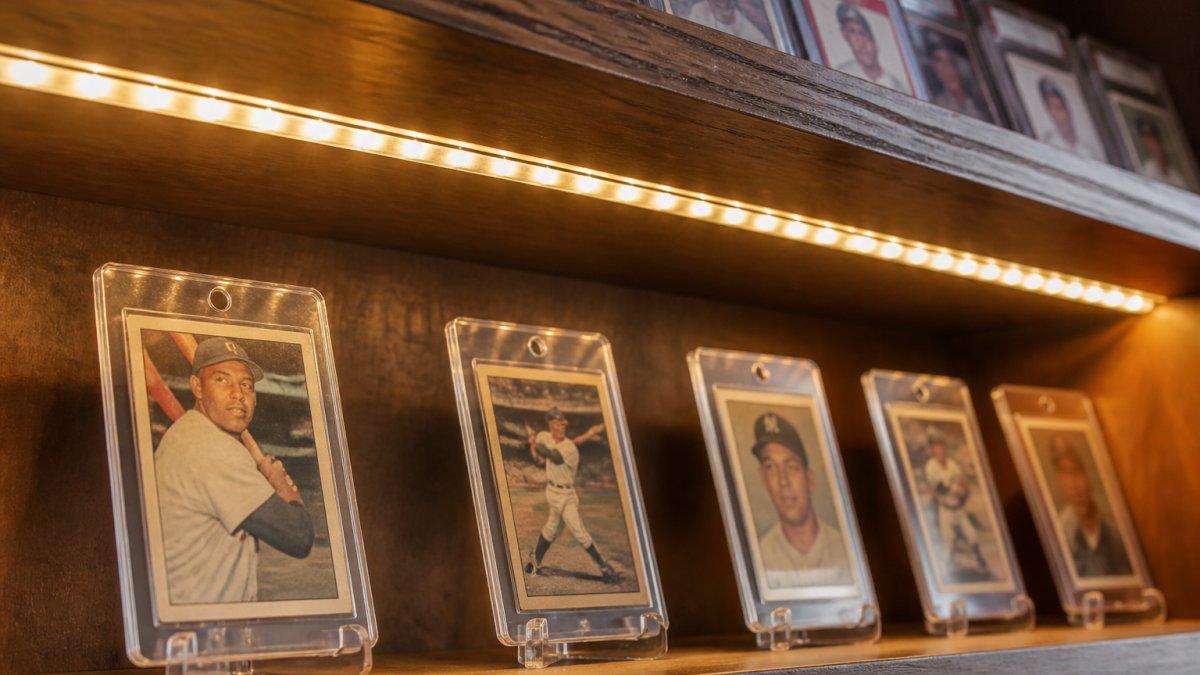
LED Strips and Corner-Bending Installation
LED strips are the workhorse for shelf and case lighting.
A common mistake is mounting strips so the light hits the card face directly. That produces a hot spot and washes out the card's surface.
For corner-bending installation, look for strips rated for tight bends, and use corner connectors rather than folding the strip itself. Folding a standard strip at a sharp angle can crack the circuit and kill a whole run.
Push Lights and Simple Retrofit Options
LED push lights are the fastest retrofit for a single case, a rental, or a display you don't want to wire. They stick on, run on batteries, and give you a soft pool of light with zero installation.
The trade-off is brightness and coverage. Push lights work well for one or two cards in a small case.
For a middle ground, look at battery puck lights with a remote. You get more output than a basic push light and a dimmer, without running cable through a wall.
Glare-Free Lighting for Trading Cards
Glare-free lighting for trading cards comes from three things: indirect placement, matte or anti-reflective surfaces, and the right viewing angle. You can't eliminate reflections entirely on glass or acrylic, but you can move them out of your line of sight.
The single biggest cause of glare is a light source positioned between your eye and the card. If you can see the bulb reflected in the case, so can everyone else. Move the light to the side, or above and angled down, so the reflection bounces away from where you stand.
Reducing Glare and Reflections on Acrylic and Glass Cases
Acrylic and glass cases reflect whatever is in front of them, including you. A few fixes that work in practice:
- Angle the light, not the case. Tilt the fixture so light hits the card at an angle and reflects off to the side.
- Use a diffuser. A frosted cover over an LED strip spreads the light and softens hot spots.
- Light from two directions. Two weaker sources at opposite angles cancel out harsh reflections better than one bright source.
- Keep the room dimmer than the case. The brighter the case relative to the room, the less you'll see reflected in the glass.
Baseball Card Display Case Lighting Ideas for Every Room
Every room needs a different approach, because the light you're fighting is different. A wall-mounted case in a bright living room has the opposite problem from a case in a dark basement.
Lighting for Wall-Mounted and Lockable Display Cases
Wall-mounted and lockable cases need light that reaches the cards without washing them out. The cleanest setup is a thin LED strip tucked under the top edge of the case's frame, angled down and back toward the cards. It lights the display without putting a bulb in your sightline.
If the case is lockable and sealed, keep the light source outside the case where possible. That keeps heat and wiring away from the cards and makes the case easier to open and clean.
Brightening Dark Basements and Display Rooms
Dark basements are the easiest place to get great card lighting, because you control every photon. Start with a dim room-level light so you can move around safely, then add focused case lighting for the cards themselves.
Layer it:
- Ambient: a dim overhead or floor lamp for general visibility.
- Task: LED strips or pucks inside each case for the cards.
- Accent: a small spotlight on a single prized piece.
This three-layer approach is what separates a display room from a shelf with a light on it. It also lets you keep the room dim enough that case reflections disappear.
Light Boxes and Photography Lighting for Card Photos
A light box is for photographing cards, not displaying them. It gives you even, shadow-free light so a card's surface, corners, and centering show up clearly in a photo. For selling, insuring, or cataloging a collection, that matters.
For display, a light box is the wrong tool. It's bright, it's directional, and it puts a lot of light on the card in a short time. Use it to shoot the card, then put the card back in its case under softer, angled display light.
If you're shooting cards, a few practical notes:
- Use two lights at 45-degree angles for even coverage.
- Keep the card flat and the camera parallel to avoid distortion.
- Use neutral white light so the card's colors stay accurate in the photo.
Protecting Cards: UV Exposure, Heat, and Long-Term Preservation
The two things that damage displayed cards are ultraviolet light and heat, and both come from your lighting choices. UV fades inks and yellows paper over time. Heat warps cards and speeds up that fading.
LED lighting solves most of the heat problem, since LEDs run far cooler than incandescent or halogen bulbs. For UV, the fix is a combination of the right bulb and the right case.
- Choose low-UV LEDs. Most modern LEDs emit very little UV compared to older bulb types.
- Use UV-filtering cases or sleeves. Many display cases and holders are sold with UV protection built in.
- Keep cards out of direct sunlight. Sunlight is the biggest UV source in any room, and no bulb comes close.
- Watch the heat. Even low heat adds up over years in a sealed case, so ventilate where you can.
The Library of Congress guidance on preserving paper collections is a solid reference for how light, heat, and humidity affect paper over the long term.
What to Ignore When Buying Display Lighting
Most display lighting marketing is aimed at the wrong problem. Here's what to skip.
- "Brightest" claims. Brightness without control just creates glare and heat. You want the right brightness, not the most.
- Warm, cozy color tones. They look great in a living room and terrible on a card. Stick with neutral white.
- Cheap non-dimmable fixtures. No dimmer means no way to tune the room. It's the one feature worth paying for.
- Bulbs with no CRI rating listed. If the maker won't tell you the color rendering, assume it's poor.
- Display cases with built-in lights and no ventilation. Trapped heat is a slow problem you won't notice until the cards show it.
If you're building out a room around your collection, the lighting is only half the story. The other half is what you put in the space. At MoonlightWeave, we turn vintage memorabilia into handcrafted fabric goods and home accessories, from cozy blankets and luggage tags to functional decor like doormats, clocks, and cutting boards. It's a way to keep the nostalgia of the game in your everyday life, not just behind glass.
Lighting a card room well takes some thought, but it's not complicated once you know the rules: neutral white LED, angled to kill glare, cool to protect the cards. The hard part is building a room worth lighting. MoonlightWeave can help there, with handcrafted pieces made from real vintage memorabilia, including nostalgic blankets, custom clocks, and one-of-a-kind decor that turns a display room into a space you actually want to spend time in.
Frequently Asked Questions
How can I light a baseball card display case without glare?
Use diffused LED strips or push lights mounted at the top or sides of the case, angled down and slightly back so light hits the card at a shallow angle. Avoid pointing lights directly at the front of acrylic or glass, which creates hot spots. Neutral white LEDs around 4000K to 5000K give clear color rendition without washing out card details. A matte backing behind cards also cuts reflections.
Are LED lights safe for displaying baseball cards?
Yes. LEDs emit very little UV compared to halogen or fluorescent bulbs, and they run cool, so they will not bake card slabs or warp vintage cardboard. Look for LEDs rated low-UV or UV-free, keep them a few inches away from card surfaces, and avoid running them 24/7. Even low-UV light adds up over years, so use a timer or switch and keep cases out of direct sunlight.
What color temperature is best for a baseball card display room?
Neutral white, around 4000K to 5000K, works best for most display rooms. It renders team colors and card borders accurately without the yellow cast of warm bulbs or the clinical blue of 6000K and above. For a cozier room, mix 3000K ambient lighting with 4000K to 5000K task lighting inside the cases. Keep one consistent temperature per case so graded cards and autographs look uniform.
Where should lights be placed in a baseball card display case?
Place lights at the top of the case aimed downward, or along the sides aimed across the card face. Top-mounted LED strips work well for shelves and graded card slabs; side placement helps wall-mounted and lockable cases in dark basements. Keep the light source at least 2 to 3 inches from the card, angle it to graze rather than blast the surface, and test placement before mounting anything permanently.